Fénis Castle - Aosta
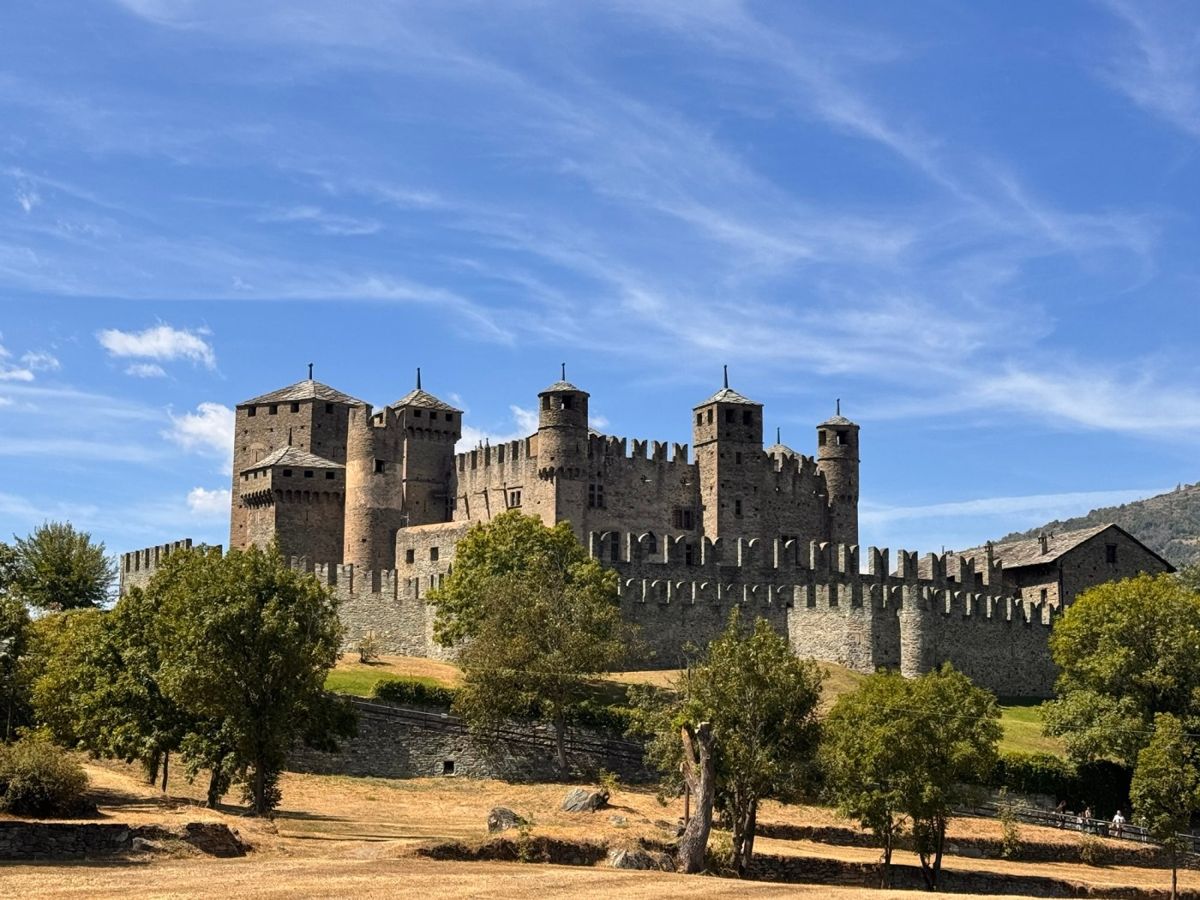
Fénis Castle: between history, symbols and Templar legends
Fénis Castle, in the heart of the Aosta Valley, is one of the most famous and most visited medieval monuments in the region. Built and enlarged between the 14th and 15th centuries by the powerful Challant family, it was not a military fortress but a noble residence. Its towers, double ring of walls and inner courtyard served the needs of display and prestige more than any real defensive need [Cignitti 1988; Sergi 2000].
A jewel of architecture and painting
The castle interior preserves an extraordinary cycle of 15th-century frescoes, attributed to Lombard and Piedmontese masters [Cignitti 1988]. The courtyard is dominated by figures of saints, prophets and moral allegories, alongside a cycle of painted Proverbs featuring knights, animals and mottoes written in Franco-Provençal and Old French.
A famous example reads: "Qui trop parole, il dit folie" ("Who talks too much speaks folly"), accompanied by the figure of an armed knight. Other sayings associate virtues and vices with animal figures: the lion for courage, the wolf for deceit, the bear for brute strength. These paintings had an educational and moral function, intended for those who lived in and visited the residence [D’Arco 1995].
The allure of mystery
The symbolic richness of the frescoes and certain heraldic details fuelled, between the 19th and 20th centuries, hypotheses and legendary tales linking the castle to the Order of the Knights Templar, suppressed by Pope Clement V in 1312 [Barber 1992; Frale 2001].
Several elements gave rise to these suggestions:
The proverbs and frescoed knights
Some scholars of iconology have suggested that the moral maxims might conceal an initiatory language, akin to that of the Templar chapters, where silence and discipline were central values [Frale 2001].
Heraldic crosses
Some carved stones and Challant decorations bear equal-armed crosses or crosses pattée, similar to Templar ones. In fact these are very common motifs in medieval heraldry [Klaniczay 2006], but the symbolic resemblance encouraged the association with the Templar world.
Enigmatic knights
Some knightly figures appear isolated, in almost ritual poses. In modern times they have been interpreted as "guardians" or allusions to the legend of the Holy Grail, a myth often intertwined with the fate of the Templars [Baigent–Leigh–Lincoln 1982].
Legends of underground passages
Popular tradition says that beneath the castle there were secret tunnels or walled-up crypts where Templar relics or manuscripts were hidden. There is no archaeological evidence for this, but local folklore hands down the belief that "metallic noises" came from the foundations, attributed to knights still watching over their treasure [oral traditions collected in Bertolotti 1974].
History or legend?
Historically, there are no documents attesting a Templar presence at Fénis. The castle was always linked to the Challant family and their desire to assert prestige and power in the region. However, the collective imagination has turned the manor into a crossroads of chivalric myths: the actual symbols (frescoes, proverbs, heraldic crosses) have been reread in a mysterious and Templar key, weaving together reality and legend.
A heritage of suggestion
Today Fénis Castle offers visitors not only a splendid example of Alpine medieval architecture but also a place of enigmas, where documented history merges with popular narrative. It is precisely this interweaving of document and myth that continues to make it one of the most fascinating sites in the Aosta Valley: a noble residence, but also a stage for legends evoking the Templars, the Grail and the hidden secrets of the Middle Ages.
Essential bibliography
Baigent, M. – Leigh, R. – Lincoln, H. (1982). Holy Blood, Holy Grail. London: Jonathan Cape.
Barber, M. (1992). The New Knighthood: A History of the Order of the Temple. Cambridge: Cambridge University Press.
Bertolotti, S. (1974). Leggende e tradizioni della Valle d’Aosta. Turin: Einaudi.
Cignitti, G. (1988). Il Castello di Fénis e gli affreschi del cortile. Aosta: Musumeci.
D’Arco, L. (1995). Simboli e proverbi nel Medioevo alpino: il ciclo di Fénis. Milan: Jaca Book.
Frale, B. (2001). I Templari. Rome-Bari: Laterza.
Klaniczay, G. (2006). Holy Rulers and Blessed Princesses: Dynastic Cults in Medieval Central Europe. Cambridge: Cambridge University Press.
Sergi, G. (2000). L’aristocrazia della Valle d’Aosta medievale. Turin: Einaudi.
Originally published in Italian on the Montezaga blog (montezaga.wordpress.com) →