Pieve di San Floriano - San Pietro in Cariano

The Pieve (parish church) of San Floriano, in San Pietro in Cariano, is a historical and artistic gem of the Valpolicella, in the province of Verona. This sacred building is one of the most significant examples of Romanesque architecture in the region, and is known for its beauty and for the symbolic value it has held in the religious and cultural history of the area.
Origins and History
The construction of the Pieve dates from the 11th–12th centuries, but its foundations may be even older, perhaps linked to an earlier pagan site. This theory is supported by finds suggesting the presence of a place of worship in Roman times or earlier. Pievi were in fact often built over existing sacred places, integrating pagan traditions into the new Christian context.
Saint Florian, also known as Florian of Lorch, is a historical and religious figure of great importance, venerated as a martyr saint by the Catholic Church. His story dates back to the 4th century AD, during the reign of the emperor Diocletian, known for his persecutions of Christians.
Historical Role and Religious Significance
The Pieve of San Floriano played a fundamental role in the religious and social history of the Valpolicella. Like all pievi, it was the centre of a large territory, called a "plebania", which included many small communities. The priests of the pieve were responsible for the spiritual care of the faithful, and baptisms, weddings and other ceremonies were often celebrated here.
Besides its liturgical function, the Pieve was also a gathering place for the community, where markets, assemblies and other social events were held. This link between religious and everyday life helped consolidate the Pieve's role as the beating heart of the community.
Who was Saint Florian?
Saint Florian was a Roman soldier stationed in the province of Noricum, corresponding to present-day Austria. He held the post of princeps officii, a senior administrative position in the Roman army. Despite his military career, Florian secretly practised the Christian religion, a courageous act at a time when Christianity was persecuted.
The Martyrdom
In AD 304, during one of the fiercest persecutions of Christians, Florian decided to join a group of forty Christians arrested at Lauriacum (today Lorch). After voluntarily giving himself up to the Roman authorities and confessing his faith, he was tortured. Finally he was condemned to death and thrown into the river Enns with a millstone tied around his neck, a symbol of his unshakeable faith.
The Cult of Saint Florian
After his death, Florian's body was recovered and buried by the matron Valeria. The Abbey of Sankt Florian, one of the most famous Baroque monuments in Austria, was later built on the site of his burial. Saint Florian's relics were taken to Rome in the 12th century and distributed to various places, including Kraków, where the saint is particularly venerated.
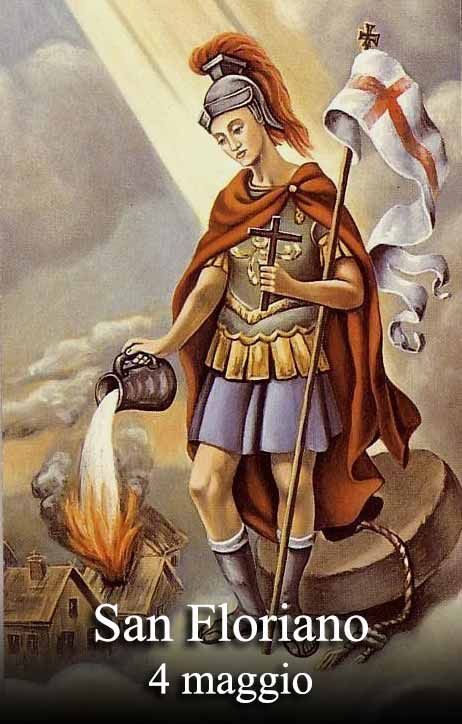
Saint Florian is invoked as a protector against fire and flood, and his cult is widespread in Austria, Bavaria, Poland and Italy. He is also the patron saint of firefighters, thanks to the legend that he put out a fire with a single bucket of water.
Symbolism and Iconography
Saint Florian is often depicted with a bucket of water and a millstone, symbols of his martyrdom and of his protection against natural disasters. His figure represents courage and faith in times of hardship.
Originally published in Italian on the Montezaga blog (montezaga.wordpress.com) →