Santa Maria della Rocca in Offida: history, architecture, painting and the enigma of the cross pattée

Introduction: a monument between documented history and the memory of mystery
On the western edge of the medieval town of Offida, where the rocky spur breaks off abruptly into the deep natural ravines surrounding the village, stands one of the most unusual religious buildings in the southern Marche: Santa Maria della Rocca.
The building's position already offers a first key to its interpretation. Santa Maria does not simply occupy a square or a central area of the town: it is built on the physical edge of the settlement, in a place that before the 14th-century church had served a defensive function. Documentary tradition traces the origin of the complex to a castle of the Lombard period, with a small church, which later came into the possession of the Abbey of Farfa. In 1039 the complex was donated to the abbey, passing into the orbit of the Benedictine monks.
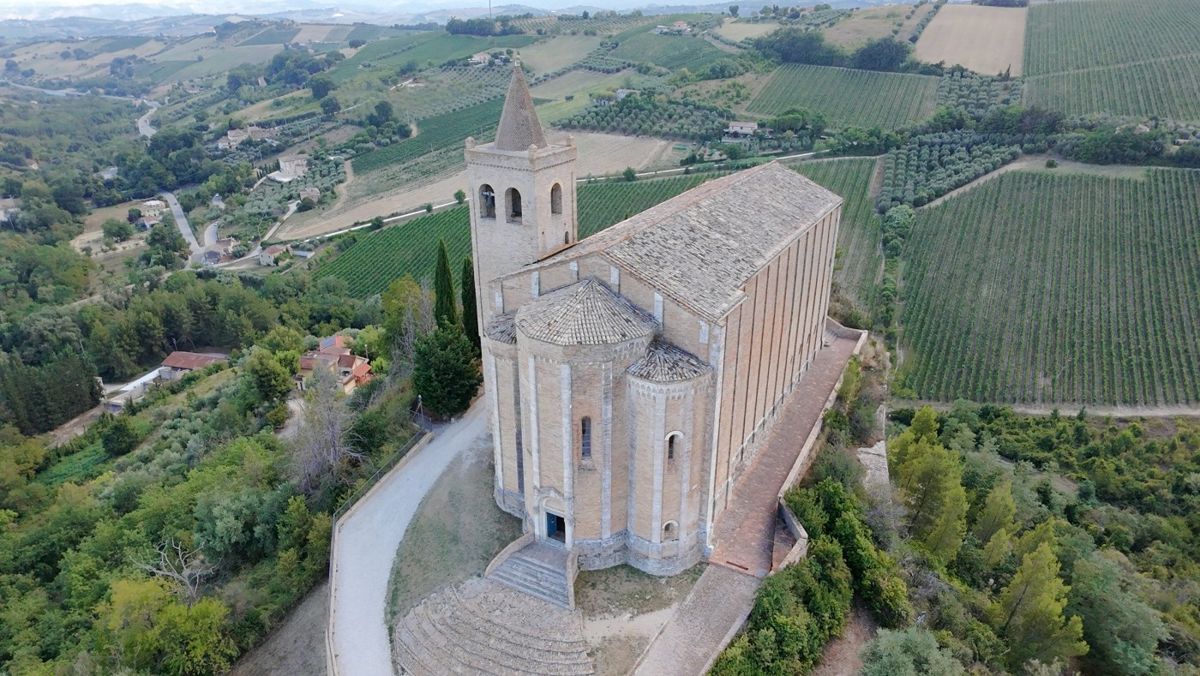
The present building, on the other hand, belongs to the 14th century. An inscription records the work of 1330, when the earlier fortified complex was partly demolished to make way for a much larger church. The new construction did not, however, entirely erase the earlier one: some of its structures were incorporated into the new building, creating an anomalous and particularly interesting architectural configuration.
It is precisely this superimposition that makes Santa Maria della Rocca a monument particularly suited to research on medieval survivals.
The church is at the same time:
- a place of worship;
- evidence of the Benedictine settlement;
- a building constructed on an earlier fortified site;
- a document of Romanesque-Gothic architectural culture;
- the home of an extraordinary painted heritage;
- a place where signs and symbols survive whose interpretation is not always straightforward.
Among the latter, tradition points to a cross pattée carved on the masonry, an element that has fuelled the hypothesis of a possible link with the Knights Templar.
And this is precisely the point at which documented history meets the problem of mystery.
The presence of a cross pattée is indeed a fact worth observing and studying; on its own, however, it is not proof of a Templar presence.
The difference is substantial.
A serious investigation must therefore start from the certain history of the building, reconstruct its religious and territorial context, and only then ask whether the symbolic clues can be related to the Order of the Temple.
1. Before the church: the castle and the Farfa presence
To understand Santa Maria della Rocca we need to go back well before the 14th century.
The area where the church now stands was already occupied in the Middle Ages by a fortified settlement. Institutional sources describe the earlier complex as a castle of the Lombard period, associated with a small church. In 1039 the castle and the church were donated to the Abbey of Farfa.
This step is fundamental because it establishes a concrete historical fact: the first clearly documented institutional framework of Santa Maria della Rocca is not Templar, but Farfa and Benedictine.
In the Middle Ages the Abbey of Farfa was one of the great monastic powers of central Italy. Control of churches, land and settlements allowed monasteries to become part of territorial networks far wider than individual towns.
The Farfa presence in Offida must therefore be interpreted within the framework of the progressive religious and territorial organisation of medieval central Italy.
The placing of the church on an earlier fortified structure is not in itself exceptional. In the Middle Ages religious buildings could occupy areas previously used for military, administrative or residential purposes.
In Offida, however, the transformation is particularly evident.
The place that had been a point of territorial control was gradually transformed into a great church space.
The fortification disappeared, but the geography of power remained.
The church continued to occupy the dominant point of the promontory, keeping a privileged relationship with the surrounding landscape.
This topographical continuity is also important for understanding the character of the later building.
2. The great building campaign of 1330
The decisive moment in the history of Santa Maria della Rocca is 1330.
An inscription records the start of work to demolish the earlier castle and build a larger church. The earlier church, however, was not completely removed: it was partly incorporated into the new building.
The result was a complex building, in which the new architecture had to come to terms physically with what already stood there.
This is particularly important because it allows the church to be interpreted as a layered structure rather than as a building designed and built in a single phase.
The 14th-century construction belongs to the Romanesque-Gothic idiom of central Italy. The predominant use of brick produces a strong unity of colour and material, while the organisation of space reveals an evolution towards Gothic forms.
Its position on the cliff also conditions the very structure of the building.
The church appears almost as a mass built on the edge of the void.
The relationship between architecture and landscape is therefore not a secondary element. The shape of the terrain determines how the church is perceived and, to some extent, its spatial organisation too.
The medieval building does not try to hide its relationship with the precipice: it embraces it as part of its own identity.
3. A church above and a church below
One of the most interesting aspects of Santa Maria della Rocca is the presence of two closely integrated levels.
The upper church consists of a large single-nave hall, beneath which lies the crypt.
The crypt occupies practically the entire area of the upper building and is characterised by brick columns and a succession of pointed and round arches.
The configuration of the crypt derives largely from the building history of the church.
The earlier church was not simply demolished and replaced by a new structure: it was incorporated and reinterpreted within the new design.
The result was a series of corridors and side spaces that still allow us to perceive the complexity of the transformation. One of these rooms was later used as a burial area, from the 16th century onwards.
The crypt thus takes on a function that goes beyond the liturgical.
It is, in an almost archaeological sense, the place where the church preserves the memory of its construction.
The lower walls make visible what the monumentality of the upper church tends to hide.
For this reason a visit to Santa Maria della Rocca should ideally follow a vertical route: from the landscape to the façade, from the nave to the crypt, from the most recent structures to the traces of earlier buildings.
The history of the building is read by going down.
4. Architecture as a document
The west façade, relatively plain in structure, follows the logic of the brick architecture found in many religious buildings of central Italy.
The portal, the rose window and the decorative elements concentrate the ornament at selected points, while the large wall surfaces remain austere.
The east side, by contrast, is more complex.
The apse area comprises three polygonal apses and a vertical articulation in which walls, openings and supporting elements create a strong sense of verticality.
The upper church is organised around a large nave, with an eastern area marked by the apses.
The overall effect is of an architecture in which the Romanesque language is not simply replaced by the Gothic but coexists with it.
It is precisely this coexistence that makes it reductive to define Santa Maria della Rocca as simply a "Gothic church".
The building belongs to a phase of transition and blending of idioms, characteristic of a large part of the religious architecture of central Italy.
Brick, moreover, is not a purely aesthetic choice.
It is the material best suited to the resources and building traditions of the area, and its use links Santa Maria della Rocca to the building culture of the medieval Marche.
5. The painting of the crypt: the Master of Offida
If the architecture allows us to reconstruct the material history of the complex, the painting introduces a second dimension: that of religious culture.
The frescoes of the crypt are among the most important features of the building and are largely associated with the so-called Master of Offida, an anonymous figure of central Italian painting in the 14th and 15th centuries.
The name "Master of Offida" therefore does not refer to an artist whose name we know, but to a conventional art-historical identity constructed on the basis of a coherent group of works.
His activity has been linked with an area much wider than Offida, including the southern Marche and Abruzzo. Specialist literature has identified works attributable to the same artist or his circle in several centres of central Italy.
At Santa Maria della Rocca several frescoes in the crypt are attributed to him.
The main subjects include the cycles dedicated to Saint Catherine of Alexandria and Saint Lucy, as well as images of saints and enthroned Virgins.
The painting of the Master of Offida belongs to the spread of Giottesque culture in central Italy, but it cannot be interpreted simply as a provincial copy of Giotto.
Rather, it shows the process by which innovative figurative models were absorbed and transformed in different regions.
The dating of some paintings is particularly significant.
An inscription in the church allows some frescoes in the transept to be dated to 1367, providing a valuable chronological reference for reconstructing the decoration of the complex.
This places the painted decoration in a phase relatively close to the great building campaign begun in 1330.
The church, then, was not simply built and decorated in widely separated periods.
The great architectural transformation and the definition of its figurative programme belong to a single process of building a new religious identity for the place.
6. The iconographic programme
The frescoes of the crypt must be read as a whole.
The figures of saints, the enthroned Virgins and the narrative cycles are not randomly distributed on the walls.
Medieval painting organised space through images with didactic, liturgical, devotional and commemorative functions.
Saint Catherine of Alexandria and Saint Lucy are female figures united by martyrdom and faithfulness to the Christian faith. Their presence in the crypt therefore takes on a particularly strong meaning in a space defined by its underground and funerary character.
The crypt is the space of depth.
Here sacred painting confronts the dimension of death and burial.
It is no coincidence that one of the rooms of the old structure was later used for burials.
The relationship between images of saints, the cult of the dead and underground space is therefore one of the most interesting aspects for an anthropological reading of the complex.
The frescoes do not simply decorate a crypt: they help to transform it into a space in which death is placed in the perspective of salvation.
7. Ugolino di Vanne and the renewal of the 15th century
The painted history of the church does not end with the 14th century.
The upper church preserves a second important decorative phase associated with Ugolino di Vanne da Milano.
The apse conch depicts prophets, holy virgins and musician angels.
This decoration belongs to a later phase than the great 14th-century cycles and bears witness to the continuous updating of the building.
A local documentary tradition places an important painting campaign by Ugolino di Vanne in 1423, commissioned by the prior of the monastery with contributions from some private individuals.
The date is important because it shows that Santa Maria della Rocca remained a living, active place even after the end of the great 14th-century building phase.
The apse programme also introduces a strongly liturgical dimension.
The musician angels ideally accompany the heavenly liturgy, while prophets and virgins form a kind of sacred court around the Marian and Christological dimension of the apse.
Painting is therefore not only a memory of the past.
It is also the result of the liturgical and representational needs of the monastic community.
8. The presence of Vincenzo Pagani
One of the church's Renaissance works belongs to a still later phase.
On the wall opposite the apse are recorded a Deposition, a Crucifixion and a Madonna and Child with a Saint, the last attributed to Vincenzo Pagani. Sources describe this work as the only Renaissance fresco preserved in the complex.
The presence of Pagani introduces a further layer.
The pictorial language of the Renaissance is superimposed on the medieval one without completely erasing it.
Santa Maria della Rocca thus becomes a kind of visual archive.
The 14th century, the early 15th century and the Renaissance coexist within the same space.
This characteristic is essential to avoid an excessively "Templar" or esoteric reading of the building.
The monument has an artistic history that is fully documentable, extremely rich and complex.
The mystery, if it exists, must be sought within this history, not as a substitute for it.
9. The cross pattée: the sign that fuels the Templar hypothesis
We come, then, to the detail that has most fuelled interest in a possible link between Santa Maria della Rocca and the Order of the Temple: the presence of a cross pattée carved on the masonry.
The symbol has a strong evocative power.
The cross pattée is one of the cross forms most associated with the Templars in the contemporary imagination.
But imagination cannot replace history.
We must start from a fundamental principle of art-historical method: a symbol does not necessarily have a single meaning.
The cross is, first and foremost, the fundamental symbol of Christianity.
Its many variants were used by religious orders, confraternities, communities, pilgrims, patrons and individual believers.
A cross pattée may therefore indicate a Templar context, but it may also belong to a wider symbolic tradition.
To attribute a carving to a particular order, it is not enough to recognise its shape.
We need to establish:
when was it made?
by whom?
where in the building is it?
which building phase does it belong to?
does it have technical features compatible with other carvings that are certainly Templar?
are there documents linking the place to a member or a property of the Order?
Without this information, the symbol remains an iconographic clue.
It is not yet historical proof.
10. Why the Templar hypothesis is nonetheless interesting
Recognising the weakness of the cross as evidence does not mean the question should be abandoned.
Quite the opposite.
It makes it more interesting.
The first element to consider is the chronological context.
The Order of the Temple was suppressed in 1312, while the great building campaign at Santa Maria della Rocca began in 1330.
This fact calls for fundamental caution.
If the cross pattée had been made at the same time as the 14th-century construction, it would postdate the suppression of the Order.
In that case it could not automatically be used as proof of an official Templar presence on the building site.
But this observation does not settle the matter.
The cross might predate the present church and belong to an earlier structure.
Or it might have been made later, for devotional or commemorative reasons.
It might even be a sign with no connection to the Order.
The date of the carving thus becomes the central question.
And it is precisely on this point that a specific scientific investigation would be desirable.
11. The problem of the survival of signs
Another element to consider is the material nature of the cross.
A carving on masonry is not necessarily contemporary with the construction of the wall on which it appears.
This problem is particularly important in medieval buildings, where wall surfaces could be reused again and again.
A wall could be:
- built;
- plastered;
- frescoed;
- repainted;
- stripped;
- restored;
- carved;
- plastered again.
Consequently, the physical position of a sign does not automatically determine its date.
The wall surface must be studied as a stratigraphic document.
In the case of the cross pattée, it would therefore be necessary to check its relationship with the layers of plaster and paint, analyse any overlap with other interventions and establish whether the carving was made before or after particular decorative campaigns.
Such an approach could turn an apparently enigmatic element into a concrete historical fact.
12. The Templars in Piceno: the regional context
The hypothesis, however, does not arise in a vacuum.
The Piceno area preserves a particularly strong memory of its relationship with the Templars.
The most obvious case is Castignano, a town in the hinterland of Ascoli.
Local tradition and contemporary institutional communication link the village to the presence and passage of the Templars, so much so that Castignano is now presented as one of the main places in the Marche associated with the memory of the Order.
The municipality itself presents the Templaria Festival as a re-enactment dedicated to the history of the Templars and maintains that their passage left traces in local history, economy and tradition.
This context makes it understandable that the question should also arise for Offida.
Castignano and Offida belong to the same wider historical area of Piceno.
But once again a logical error must be avoided.
A documented or traditionally attested Templar presence in a nearby town does not prove the presence of the Templars in another town.
A territory can be crossed by the same economic and road networks without every religious building in it being Templar.
Territorial comparison is therefore useful for formulating hypotheses, not for turning them into certainties.
13. The role of communication routes
To understand the possible presence of military orders in Piceno, we must also consider medieval mobility.
The religious-military orders did not consist only of knights fighting in the East.
They had a complex organisational structure based on properties, churches, hospitals, agricultural resources, support networks and relations with church and lay authorities.
Their Western houses were thus part of territorial systems.
Piceno, facing the Adriatic and connected to the Apennine interior, lay within a geography in which travel towards Rome and towards the Adriatic ports was particularly important.
It is therefore historically plausible that the area was crossed by people, goods, pilgrims and religious heading for various centres of the peninsula and for the East.
But the plausibility of passage is not proof of a Templar foundation.
We need to distinguish between:
territorial presence,
transit,
ownership of property,
management of a church,
residence of members of the Order.
These are historically different categories.
14. The relationship with Farfa and the problem of overlap
In the case of Santa Maria della Rocca there is also a fact that makes caution particularly important.
The available documentation clearly indicates a Farfa and Benedictine framework.
If one wished to demonstrate a later Templar presence, it would therefore be necessary to explain when it would have entered a structure already belonging to another religious institution.
This would not be impossible.
In the Middle Ages church properties, rights, grants and forms of administration could change over time.
But documentation capable of proving it would be needed.
A carved cross alone does not solve this institutional problem.
For this reason, genuine research into a possible Templar link should start from the Farfa archives and the documentation on the abbey's properties in the Offida area, checking whether the documents contain references to military orders, confraternities, donations or transfers of ownership.
This would be a much more productive line of research than simply comparing symbols visually.
15. The cross as a possible memory, not necessarily a signature
There is also an interpretative possibility that deserves attention.
Even if the cross pattée were shown to be medieval, it would not automatically have to be interpreted as a "signature" of the Order of the Temple.
Medieval symbols did not necessarily work like modern trademarks.
A cross could have a devotional, commemorative or votive function.
It could have been carved by a pilgrim.
By a member of a confraternity.
By a believer.
By a member of the clergy.
By a craftsman.
By a traveller.
Or it could have had a function we are no longer able to reconstruct today.
The right question, therefore, is not simply:
"Is it a Templar cross?"
The more useful question is:
"What function did this cross have in the historical context in which it was carved?"
Only after answering the second question will it be possible to tackle the first seriously.
16. Santa Maria della Rocca as a palimpsest
Perhaps this is the true peculiarity of Santa Maria della Rocca.
The building can be read as a historical palimpsest.
Beneath the 14th-century church lies the memory of the earlier structure.
Beneath the monumental upper church survives the crypt.
Beneath the 15th-century decoration remain the 14th-century cycles.
Beneath later paintings older layers are preserved.
And perhaps, on the surface of the walls, signs made at different times remain.
The building, then, does not have a single history.
It has many superimposed histories.
It is precisely this characteristic that makes it methodologically plausible to search for signs that may belong to different phases.
But it is also the same characteristic that makes any hasty interpretation dangerous.
17. "Mystery" as a historical problem
With a place described as "mysterious", the temptation is to start from the legend and use the material evidence to confirm it.
A research approach should proceed the other way round.
First comes the document.
Then material observation.
Then interpretation.
Finally, if unexplained elements remain, the mystery is born.
Santa Maria della Rocca is a perfect example of this process.
Its documented history is already complex enough:
an ancient castle;
a church;
the donation to Farfa in 1039;
the Benedictine presence;
the great rebuilding of 1330;
the incorporation of the earlier church;
the construction of the crypt;
the 14th-century decoration;
the Master of Offida;
the later campaign of Ugolino di Vanne;
the Renaissance works;
the later transformations.
All this is history.
The cross pattée, on the other hand, belongs to the category of traces to be interpreted.
It is this distinction that preserves the value of the investigation.
18. What research could solve the enigma?
To genuinely test the Templar hypothesis, interdisciplinary research would be desirable.
The first level should be documentary.
It would be necessary to examine:
- the records of the Abbey of Farfa;
- medieval notarial deeds relating to Offida;
- episcopal documents;
- registers of church property;
- wills and bequests;
- any documents relating to the military orders in Piceno;
- sources on the suppression of the Templars and the subsequent redistribution of their property.
The second level should be art-historical.
The cross should be compared with a corpus of similar crosses in medieval buildings in the region.
The third level should be archaeological.
It would be necessary to establish the stratigraphic relationship between carving, masonry, plaster and paint.
The fourth level could be digital analysis.
High-resolution photogrammetry, multispectral imaging and 3D scanning could make it possible to document the sign and compare it with other carvings.
Finally, all the data would need to be brought together.
Only from the convergence of documents, stratigraphy, material analysis and iconographic comparison could a truly solid conclusion emerge.
19. What can we say today?
In the light of the information available, some conclusions can be drawn with reasonable confidence.
First: Santa Maria della Rocca stands on a site previously occupied by a castle of the Lombard period and a small church.
Second: in 1039 the complex was donated to the Abbey of Farfa and passed into the Benedictine orbit.
Third: in 1330 construction of the present large church began, incorporating part of the earlier structure.
Fourth: the church is an important example of the Romanesque-Gothic brick architecture of central Italy.
Fifth: the crypt preserves important 14th-century painted cycles attributed to the Master of Offida, including those dedicated to Saint Catherine of Alexandria and Saint Lucy.
Sixth: the upper church preserves significant decoration attributed to Ugolino di Vanne da Milano and later works, including a fresco attributed to Vincenzo Pagani.
Seventh: the Piceno area has a strong historical and cultural tradition linked to the presence of the Templars, particularly evident in the case of Castignano.
Eighth: the presence of a cross pattée at Santa Maria della Rocca is an element worth studying, but in the absence of further evidence it is not sufficient to prove a Templar presence in the church.
This last conclusion is perhaps the most important.
20. One cross, three possibilities
The cross pattée of Santa Maria della Rocca can be considered in at least three different scenarios.
First scenario: a generic Christian symbol
The carving could be a simple depiction of the cross, made in the context of medieval or post-medieval devotion.
In this case the Templar connection would be purely interpretative.
Second scenario: the memory of a milieu linked to the military orders
The cross could belong to a context in which members, pilgrims or supporters of the military orders were present.
This would be more interesting, but would still require supporting documentation.
Third scenario: genuine Templar evidence
The strongest hypothesis would be that the cross was contemporary with a documented presence of the Order of the Temple.
To support it, however, further elements would be needed: documents, inscriptions, archaeological comparisons or other symbols convincingly associated with the Order.
At present we do not have a sufficient basis to choose definitively between the three scenarios.
And it is precisely here that the real mystery begins.
Conclusion: the question hidden in the stone
Santa Maria della Rocca is not interesting because it might have been Templar.
It is interesting because its very structure shows how complex it is to reconstruct the medieval past.
The monument arose on an earlier fortification, was transformed into a great religious complex, incorporated an older church, became the home of important painted cycles and continued to change over the centuries.
Every generation left something behind.
Every new building incorporated part of the previous one.
Every fresco added a new interpretation of the sacred space.
And on the walls remain signs that we are not always yet able to interpret.
The cross pattée belongs to this last category.
Its appearance may immediately recall the Templar world, but history cannot be built on resemblance.
To assert a Templar presence at Santa Maria della Rocca, something more would be needed: a documentary, chronological and material connection.
The question therefore remains open.
But perhaps that is precisely what makes it more interesting.
Because the real mystery does not lie in being able to say that the Templars were here.
It lies in asking who carved that cross, when they did it and what meaning they gave to that sign.
The answer may lie in the archives.
It may lie beneath a layer of plaster.
It may emerge from a new analysis of the masonry.
Or it may never be recovered.
In any case, Santa Maria della Rocca demonstrates a fundamental truth for research on mysterious places: the past does not need to be turned into legend to become enigmatic.
Sometimes it is enough to look carefully at what remains.
And, above all, to have the courage to distinguish what we know from what we do not yet know.
The cross on the wall, then, is not an answer.
It is a question carved in stone.
Essential bibliography
Institutional and documentary sources
Comune di Offida, Santa Maria della Rocca, monument sheet and historical-architectural information.
Italia.it, Chiesa di Santa Maria della Rocca – Offida, historical-artistic sheet.
Italia.it, Offida, information on the historical and architectural heritage of the town.
Comune di Castignano, Templaria Festival, information on the Templar tradition of Castignano.
Italia.it, Castignano – Il borgo dei Templari.
Studies and art-historical references
Tartuferi, A., “Qualche osservazione sul Maestro di Offida e alcuni appunti sulla pittura del Trecento nell'Abruzzo teramano”, Arte Cristiana, 88, 2000, pp. 249–258.
Papetti, S., “Un artista itinerante fra le Marche e l'Abruzzo: il Maestro di Offida”, in Le vie e la civiltà dei pellegrinaggi nell'Italia centrale, Spoleto, 2000.
Leone de Castris, P., contributions in Documenti dell'Abruzzo Teramano. Dalla Valle del Piomba alla valle del basso Pescara, Pescara, 2001, pp. 215–225.
Crocetti, G., “Pittori del quattrocento nelle chiese farfensi delle Marche”, in Aspetti e problemi del Monachesimo nelle Marche, 1982.
Methodological note
The literature specifically devoted to the alleged Templar presence at Santa Maria della Rocca is far less substantial than the documentation on the Farfa history, architecture and painting of the building. For this reason the link with the Templars must be presented as a research hypothesis and not as an established historical attribution.
Originally published in Italian on the Montezaga blog (montezaga.wordpress.com) →