The church of San Marcello at Paruzzaro and the Last Judgement
1. Geographical setting and historical context
The church of San Marcello stands just outside the village of Paruzzaro, in the province of Novara, along the road linking Arona and Lake Maggiore, which in the Middle Ages was travelled by wayfarers, merchants and pilgrims heading for the Via Francisca and the Simplon Pass.
The building occupies a slightly raised position above the village, in an area once used as a necropolis, as shown by the tradition of using the surrounding ground as a cemetery. This setting, typical of many Romanesque pievi, underlines its role as a rural church connected with the memory of the dead and the eschatological dimension.
The church dates from the 11th–12th centuries, the height of the Romanesque period: the original structure had a single apsed nave with a timber truss roof and walls of river cobbles laid in regular courses, following building techniques common in the Novara area and the Lombard-Como region. The square bell tower, decorated with hanging arches and two-light windows, belongs to the mature Romanesque style, with close affinities to examples from the Como area.
The church of San Marcello at Paruzzaro is entirely decorated with frescoes from the 15th and 16th centuries, arranged in a visual cycle that culminates in the depiction of the Last Judgement. The Judgement, the concluding element of this catechetical cycle, reflected the provosts' urgent desire to call the community to reflect on salvation and moral responsibility.
2. The specific composition of the Last Judgement
Unlike many canonical depictions, this scene handles the divine triad in an original way:
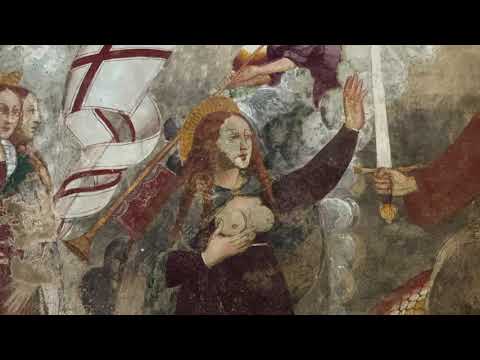
God the Father occupies the central position, reinforcing the idea of his supreme role as judge. On either side are the intercessors. On his left (the viewer's right) is Christ, showing the nail holes in his hands and the wound in his side. Beside Jesus, John the Baptist displays his severed head on a platter. On his right (the viewer's left) is the Virgin Mary, shown baring the breasts that nursed Jesus in an explicit gesture of intercession.
This arrangement symbolically highlights the proper function of each figure: divine justice, messianic redemption and maternal intercession.
3. The bare-breasted Madonna: a rare image of intercession
The enigmatic figure of the Madonna lifting her mantle to show her breasts is among the most unusual depictions of the eschatological judgement in Italian churches. Here the scene goes beyond the common Maria lactans, taking on the meaning of visual intercession: Mary offers her Son the sign of her motherhood as an argument for mercy. It is a powerful reminder of her role as mediator in salvation.
4. The eschatological dynamics of the scene
Below the divine triad the Judgement unfolds in the usual way: the Archangel Michael weighs the souls with the help of angels, the blessed ascend towards Paradise led by saints (among whom Saint Ursula and Saint Francis, for example, can be recognised), and the damned are driven towards the monstrous gate of Hell, fed by the upturned torch held by God the Father.
5. Impact and teaching function
The visual effectiveness of the scene, which combines theological rigour and iconographic invention, was clearly designed to convey two fundamental messages: the severity of divine judgement and the hope of salvation through intercession. In a rural and often illiterate setting, such images served as a true "Biblia pauperum" (Bible of the poor), stimulating meditation and emotion.
Essential bibliography
Popular and descriptive sources
Visioni dell’Aldilà: "Paruzzaro. Due immagini del Giudizio Universale" (July 2019), giving an overview of the fresco cycle and the role of the Last Judgement in the church.
Wikipedia – Chiesa di San Marcello (Paruzzaro): describes the specific iconographic arrangement, with the unusual bare-breasted Madonna.
Archeocarta Piemonte: details of the Last Judgement in the church, with information on the painting phases and the traditional composition of the divine figures.
Academic references
Casartelli Novelli, G. (1994). La pittura murale nel Novarese tra Medioevo e Rinascimento. Novara: Interlinea.
Migliavacca, G. (2002). Pittura tardogotica e rinascimentale nel Novarese. Milan: Jaca Book.
Provincia di Novara, Oratori campestri e pievi romaniche (sheet on Paruzzaro).
Originally published in Italian on the Montezaga blog (montezaga.wordpress.com) →