Cocullo
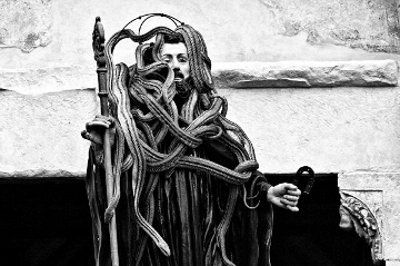
Perched on a hilltop in the upper Sagittario valley, Cocullo is a characteristic town in the province of L'Aquila in Abruzzo. Every year on 1 May a popular festival is held with a procession in honour of Saint Dominic. What makes this tradition unique is that the statue of the saint is covered with snakes, caught beforehand, according to ancient custom, by the so-called "serpari" (snake catchers). The origin of this tradition can undoubtedly be traced back to the ancient cult of the healing goddess Angitia, who came from the shores of the former Lake Fucino. Angitia (in Latin Angitia or Angita, from anguis, snake) was especially venerated by the Marsi, the Paeligni and other Osco-Umbrian peoples. The fact that the festival takes place in spring, and its association with the symbol of the serpent, are probably linked to ancient fertility rites. This particular folk event is one of many evocative examples of the absorption of ancient elements of pagan devotion into Christian worship, and it can certainly be traced back to the original myth of the Mother Goddess. It is indeed striking that the goddess venerated in central Italy finds a counterpart in Anahita, the fertility deity of ancient Persia and mother of Mithras in the mystery religion of Mithraism, and in the Assyrian fertility goddess Ishtar, associated with the eight-pointed star (a symbol that Christian iconography attributes to the Virgin Mary, mother of Jesus).
The pagan goddess Angitia is also linked to the myth of Medea. It is said that Angitia was the sister of Medea and Circe, or even Medea herself. From the union of Medea and Jason, the mythical hero of the quest for the Golden Fleece, the future king of the Marsi was said to have been born.
Bibliography:
- Dizionario dei luoghi del mito, Anna Ferrari, Bur
- Gli antichi Italici, Giacomo Devoto, Vallecchi
Originally published in Italian on the Montezaga blog (montezaga.wordpress.com) →