From Brigid to Mary: Evolution and Syncretism of a Female Cult in Medieval Ireland
Introduction
The transition from pagan to Christian Ireland is an emblematic case of how religious syncretism takes place. In this landscape of cultural and spiritual transformation, the figure of Brigid occupies a central position, forming a bridge between the cult of the Celtic goddess and the Christian veneration of the Madonna. This article analyses the path that led from the worship of the pre-Christian deity Brigid to the consolidation of the Marian cult in Ireland, highlighting the elements of continuity, adaptation and reinterpretation that characterised this syncretic process.
The pre-Christian Brigid: a multifaceted deity of the Celtic pantheon
In pre-Christian Irish tradition, Brigid (also known as Brigit, Bríg or Bríd) emerged as one of the principal female deities. Scholars agree in identifying her as a goddess with many attributes, associated mainly with three fundamental domains: poetry and inspiration, healing, and metalworking (Green, 1995). Her name, etymologically linked to the Proto-Celtic root *brig-, suggests a meaning connected with "exaltedness" or "power", corroborating her importance in the Gaelic pantheon (Ó hÓgáin, 2006).
The goddess Brigid had characteristics that would later facilitate her assimilation with Christian female figures. As Condren (1989) points out, Brigid embodied aspects of fertility and regeneration, being associated with the spring awakening and seasonal transition. Her main festival, Imbolc, celebrated on 1 February, traditionally marked the beginning of spring and coincided with the period when ewes came into milk, underlining her link with fertility and nourishment (Danaher, 1972).
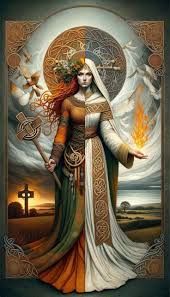
A particular aspect of Brigid's cult was her association with sacred fire and light. According to MacCana (1970), this element would prove crucial in the later Christianisation of the figure, easing her transformation into a saint and the assimilation of some of her attributes into the veneration of the Madonna. The goddess was also often represented as part of a triad, manifesting in three related but distinct aspects (poet, healer and smith), a feature reflecting the tripartite structure common to many Celtic religious conceptions (Green, 1995).
Saint Brigid of Kildare: the Christianisation of a goddess
The transition from the cult of the goddess Brigid to the veneration of the Christian saint of the same name is one of the clearest examples of religious syncretism in medieval Ireland. Saint Brigid of Kildare (c. AD 451-525) appears in the hagiographies as a historical figure, founder of an important monastery at Kildare, but her biography contains elements suggesting an overlap with the earlier pagan deity (Bitel, 2009).
The Vita Brigitae, written by the monk Cogitosus in the 7th century, is one of the main sources on the saint, and it is significant that many of the miracles attributed to Brigid directly recall qualities associated with the Celtic goddess: the multiplication of food, the power of healing and control over the natural elements (Sellner, 1989). As Harrington (2002) points out, the continuity is particularly visible in the date of celebration: Saint Brigid's feast coincides with the ancient festival of Imbolc, thus maintaining a direct calendrical connection with the earlier tradition.
An element of particular symbolic importance is the perpetual fire of Kildare. According to Gerald of Wales in the 12th century, a sacred fire burned in the monastery founded by Brigid, constantly tended by consecrated women, in a ritual continuity that directly recalls pre-Christian practices associated with the cult of the goddess (McCone, 1990). According to Ó Catháin (1999), this maintenance of fire symbolism is one of the most tangible pieces of evidence for the survival of pagan cultic elements within the new Christian context.
The many legends surrounding the birth and childhood of Saint Brigid suggest further parallels with mythical narratives. Particularly significant is the motif of the liminal birth (neither inside nor outside the house) and baptism with milk instead of water, elements that recall the liminal and fertility-related characteristics of the pre-Christian deity (Condren, 1989). As McCone (1990) shows, such hagiographical narratives functioned as a mechanism of transition, allowing earlier mythical elements to be preserved within a new Christian interpretative framework.
The syncretic process: mechanisms and dynamics
The syncretic process that led from the worship of the goddess Brigid to the veneration of Saint Brigid, and later to the assimilation of some of her attributes into the Irish Marian cult, can be analysed through several socio-cultural mechanisms.
Carney (1973) identifies functional substitution as one of the main instruments of this process: the Christianised figure of Brigid takes on many of the protective and beneficent functions previously attributed to the goddess. This phenomenon is particularly evident in Irish popular prayers and blessings, where invocations to Saint Brigid reveal a functional continuity with pre-Christian devotional practices (Ó Catháin, 1995).
Another fundamental mechanism is what Low (1996) calls the "resemanticisation of symbols", the reinterpretation of pre-existing symbolic elements within a new theological framework. Brigid's cloak, which in popular tradition miraculously spreads to cover more land than expected, can be read as a Christian reinterpretation of the concept of territorial sovereignty associated with the goddess (Ó hÓgáin, 2006).
The localisation of the sacred is a further element of continuity: many sites associated with the cult of the goddess Brigid were later Christianised and dedicated to the saint. The most emblematic is certainly Kildare (Cill Dara, "church of the oak"), where an earlier place sacred to the goddess was transformed into a Christian monastic centre (Bitel, 2009). This spatial continuity eased the transition in worship, allowing local communities to maintain a connection with places traditionally regarded as sacred.
Particularly significant is the phenomenon Ó Duinn (2005) calls the "stratification of sacred identities", the progressive overlaying of female divine figures that has characterised Irish religious evolution. In this process, attributes originally associated with Brigid were first transferred to the saint of the same name and then absorbed into Marian veneration, creating a complex palimpsest of sacred female figures.
From Saint Brigid to the Madonna: the Marian evolution of the cult
The transition from the cult of Saint Brigid to that of the Madonna represents a further phase in the syncretic process, which intensified above all from the 12th century with the reform of the Irish Church and the growing influence of continental religious orders (Watt, 1972).
Hughes (1966) identifies the Norman ecclesiastical reforms as a crucial moment in this evolution: with the introduction of a church structure more closely aligned with Roman models, the Marian cult became more central, gradually absorbing elements previously associated with Saint Brigid. This process is shown by the progressive rededication of churches and sacred places: many sites originally consecrated to Brigid were placed under the protection of the Virgin Mary (Corish, 1985).
Iconography reveals significant aspects of this transition. As documented by Harbison (1991), medieval Irish depictions show a progressive overlap of attributes: Brigid's solar symbol and cross were absorbed into Marian iconography, while the Madonna took on maternal and protective characteristics previously associated with the Irish saint. This iconographic fusion is particularly evident in sculpture and illuminated manuscripts of the 12th–14th centuries.
At the devotional level, Ó Duinn (2005) identifies a "double invocation" in popular prayers, in which Mary and Brigid are called upon together as protectors, testifying to an intermediate phase in the process of assimilation. Household blessings, especially those for the protection of home and family, show this coexistence of sacred female figures, which gradually tend to merge in popular perception.
One important aspect of this evolution is the gradual transfer to the Madonna of the association with natural elements previously linked to Brigid. The connection with water, in particular holy wells, is a significant example: many springs originally dedicated to the goddess, then to Saint Brigid, became "Marian wells" from the late Middle Ages (Nolan, 1983). Similarly, the link with fertility and the protection of women in childbirth passed progressively to the Madonna, who in Ireland took on attributes particularly tied to natural cycles and generativity (Concannon, 1938).
The Marian cult in modern Ireland: syncretic legacies
The evolution of the Marian cult in post-medieval and modern Ireland reveals the persistence of syncretic elements derived from the earlier cult of Brigid. As Taylor (1995) observes, Irish Marian devotion is distinguished by characteristics that can be traced back to this cultic stratification.
The strong popular dimension of Marian veneration in Ireland, documented by Connolly (1982), retains ritual and symbolic elements recalling pre-Christian practices: the tradition of leaving offerings and votive objects at Marian shrines, for example, shows continuity with similar practices at places sacred to Brigid. Likewise, healing and protection rituals connected with the Madonna preserve structures that anthropologists have traced to older cultic models (Ó Crualaoich, 1998).
The phenomenon of "clootie wells" (wells where rags are hung as votive offerings) is an emblematic example of continuity: originally associated with the goddess Brigid, then Christianised as the saint's wells, many of these sacred places are now dedicated to the Madonna while retaining ritual practices of clearly pre-Christian origin (Carroll, 1999).
A particularly significant aspect concerns the calendar: the feasts of the Immaculate Conception (8 December) and of the Purification/Candlemas (2 February) took on special importance in rural Ireland, the latter coinciding in time with the feast of Saint Brigid and the ancient Imbolc (Danaher, 1972). This proximity in time facilitated the transfer of ritual practices and symbolic meanings.
The persistence of these syncretic structures was also favoured by historical and political factors: as Larkin (1972) has shown, during the period of anti-Catholic persecution popular devotion focused on sacred female figures perceived as protectors of Irish identity, consolidating a particular model of Marian piety that incorporated elements of the Brigidine tradition. The Marian apparitions at Knock (1879), interpreted by Hynes (2008) as a religious response to the agrarian crisis, show how in the contemporary Irish imagination the Madonna takes on the role of protector in times of crisis, a function previously attributed to Brigid.
Conclusions
The evolution from the cult of the goddess Brigid to the veneration of the Madonna in medieval and modern Ireland offers a paradigmatic case study of the processes of religious syncretism. Far from being a simple substitution, this transformative path reveals complex dynamics of adaptation, reinterpretation and symbolic stratification.
As this study has shown, the transition passed through a crucial intermediate phase, the Christianisation of Brigid as a saint, which facilitated the transfer of attributes, functions and symbolic meanings. Continuity can be seen at several levels: in the calendar, with overlapping festivals; in space, with the Christian re-consecration of places previously dedicated to the goddess; in function, with the preservation of protective and beneficent roles; and in symbolism, with the persistence of associations with natural elements such as fire, water and fertility.
The Irish case shows that syncretic processes are not simply the top-down imposition of new religious models, but rather a complex cultural negotiation in which local communities actively reinterpret and adapt new religious elements within pre-existing structures of meaning. The particular Marian devotion that characterises contemporary Ireland can only be fully understood by taking into account this historical stratification which, through the figure of Brigid, links modern Irish Catholicism to its pre-Christian roots.
Finally, this study suggests the importance of an interdisciplinary approach integrating historical-religious, anthropological and archaeological analysis in order to understand the complex processes of continuity and transformation that characterise the evolution of religious traditions.
Bibliography
Bitel, L. M. (2009). Landscape with Two Saints: How Genovefa of Paris and Brigit of Kildare Built Christianity in Barbarian Europe. Oxford University Press.
Carney, J. (1973). The Irish Mind: Studies in Irish History and Culture. Wolfhound Press.
Carroll, M. P. (1999). Irish Pilgrimage: Holy Wells and Popular Catholic Devotion. Johns Hopkins University Press.
Concannon, M. (1938). The Sacred Conception of Motherhood. Clonmore & Reynolds.
Condren, M. (1989). The Serpent and the Goddess: Women, Religion and Power in Celtic Ireland. Harper & Row.
Connolly, S. J. (1982). Priests and People in Pre-Famine Ireland, 1780-1845. Gill & Macmillan.
Corish, P. J. (1985). The Irish Catholic Experience: A Historical Survey. Gill & Macmillan.
Danaher, K. (1972). The Year in Ireland: Irish Calendar Customs. Mercier Press.
Green, M. J. (1995). Celtic Goddesses: Warriors, Virgins and Mothers. British Museum Press.
Harbison, P. (1991). Pilgrimage in Ireland: The Monuments and the People. Syracuse University Press.
Harrington, C. (2002). Women in a Celtic Church: Ireland 450-1150. Oxford University Press.
Hughes, K. (1966). The Church in Early Irish Society. Cornell University Press.
Hynes, E. (2008). Knock: The Virgin's Apparition in Nineteenth-Century Ireland. Cork University Press.
Larkin, E. (1972). "The Devotional Revolution in Ireland, 1850-75". American Historical Review, 77(3), 625-652.
Low, M. (1996). Celtic Christianity and Nature: Early Irish and Hebridean Traditions. Edinburgh University Press.
MacCana, P. (1970). Celtic Mythology. Hamlyn.
McCone, K. (1990). Pagan Past and Christian Present in Early Irish Literature. Maynooth Monographs.
Nolan, M. L. (1983). "Irish Pilgrimage: The Different Tradition". Annals of the Association of American Geographers, 73(3), 421-438.
Ó Catháin, S. (1995). The Festival of Brigit. DBA Publications.
Ó Catháin, S. (1999). "The Festival of Brigit the Holy Woman". Celtica, 23, 231-260.
Ó Crualaoich, G. (1998). "The Merry Wake". In J. S. Donnelly & K. A. Miller (Eds.), Irish Popular Culture, 1650-1850(pp. 173-200). Irish Academic Press.
Ó Duinn, S. (2005). The Rites of Brigid: Goddess and Saint. Columba Press.
Ó hÓgáin, D. (2006). The Lore of Ireland: An Encyclopaedia of Myth, Legend and Romance. Boydell Press.
Sellner, E. C. (1989). Wisdom of the Celtic Saints. Ave Maria Press.
Taylor, L. J. (1995). Occasions of Faith: An Anthropology of Irish Catholics. University of Pennsylvania Press.
Watt, J. A. (1972). The Church in Medieval Ireland. Gill & Macmillan.
Originally published in Italian on the Montezaga blog (montezaga.wordpress.com) →