Matter and sound: the influence of building materials on the acoustics of Cistercian abbeys
Abstract
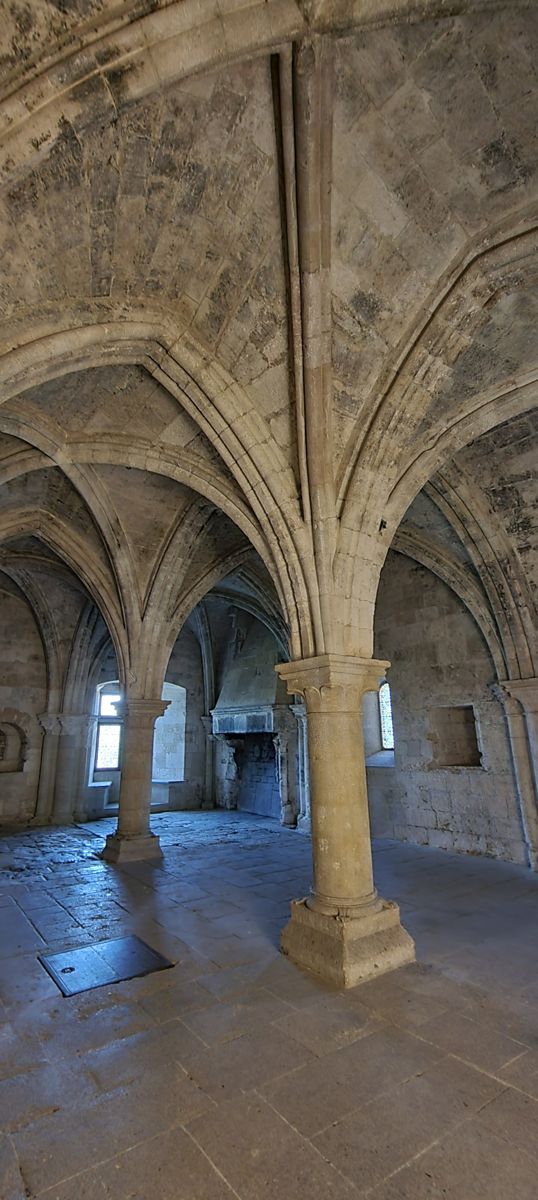
Cistercian architecture is distinguished by formal sobriety, rigorous geometry and minimal ornament, in line with the spiritual ideal of the Order. This formal purity has not only symbolic and theological value but also determines specific acoustic qualities. This article analyses the impact of building materials on the acoustics of Cistercian abbeys, with particular attention to the effects of sound reflection, absorption and diffusion. By combining archaeoacoustic data and historical sources, it highlights the connections between liturgical space, matter and the perception of sound.
1. Introduction
The Cistercian Order, founded in 1098 with the aim of restoring the purity of Benedictine monasticism, promoted an essential architecture free of superfluous ornament. This sobriety, codified in the Order's Capitula and visible in the building canons spread by Bernard of Clairvaux, also extends to the acoustic sphere. Sound in Cistercian abbeys is not an incidental effect but an integral part of the liturgical and spiritual experience. The choice of building materials plays a central role in defining a sound environment that mirrors the Cistercian ideal of silence, order and recollection.
2. Building materials in Cistercian abbeys
Cistercian abbeys are characterised by the use of simple, locally available, non-decorative materials. The most common are:
- Natural stone (limestone, sandstone, sometimes tuff), used for load-bearing structures, walls and vaults;
- Lime-based plaster, applied in thin, even layers, without polychromy;
- Terracotta or natural stone for floors;
- Limited use of wood, reserved for secondary elements such as dormitory floors or the outer roofs of ancillary buildings.
This grammar of materials reflects the Cistercian ideal of the nuda ecclesia (bare church) and is closely linked to the acoustic quality of the spaces.
3. Acoustic properties of the materials
3.1 Stone
Stone, being hard and compact, has a very low sound absorption coefficient. It reflects sound waves effectively, especially at mid and high frequencies, producing natural sustain. This contributes to the controlled reverberation typical of Cistercian naves, ideal for the propagation of Gregorian chant.
3.2 Lime plaster
Plain plaster, without decorative layers, has minimal porosity, which makes it only slightly absorbent but somewhat diffusive. This quality softens the sharp reflection of stone and improves speech intelligibility without compromising the immersive effect of the space.
3.3 Terracotta and flooring
Compared with stone, terracotta has a rougher surface and variable porosity, resulting in partial absorption of high frequencies. However, given its position, the overall effect of the floor is marginal compared with the vertical surfaces and vaults.
3.4 Absence of structural wood
The deliberate exclusion of wood from the church, in contrast with many contemporary Romanesque churches, avoids the selective absorption of high frequencies, maintaining a cooler, more reflective and more symmetrical acoustic.
4. Implications for liturgy and chant
Gregorian chant, monophonic and without instrumental accompaniment, requires spaces that favour:
- Uniform sound diffusion;
- Sustained sound without excessive echo;
- Clarity in the perception of the melodic line.
The acoustic characteristics resulting from the materials used in Cistercian abbeys fully meet these requirements, making these spaces ideal for the choral recitation of psalms and processional chant. The reflective, coherent acoustics enhance the communal effect of prayer, dissolving the distinction between individual and collective voice.
5. Archaeoacoustic studies and experimental measurements
Recent studies, including the Cistercian Sound Project (CNRS, 2018), have carried out on-site measurements in abbeys such as Fontenay, Sénanque and Fossanova, using:
- Logarithmic sweeps and binaural recordings;
- Three-dimensional digital models with acoustic ray tracing;
- Analysis of the RT60 (reverberation time) and D50 (speech definition) parameters.
The results confirm that the predominant use of stone and the absence of absorbent materials contribute to a reverberation time of between 2.5 and 4 seconds, ideal for liturgical chant but not for ordinary speech or polyphonic music, which was absent from the Cistercian liturgy of the time.
6. Conclusions
Cistercian architecture is an integrated system in which matter, form and acoustic function reinforce one another. The choice of materials does not respond only to economic or constructional logic but conveys a precise sonic ideology: sound, like light, becomes an instrument of spiritual elevation, not spectacle. Cistercian abbeys are therefore one of the highest medieval examples of integrated liturgical-acoustic design, in which matter becomes a vehicle of transcendence.
Bibliography
- Bisseret, N. (2017). L’acoustique des abbayes cisterciennes. Paris: CNRS Éditions.
- Lubman, D., & Kiser, B. (2001). The Acoustics of Worship Spaces. Proceedings of the ASA.
- Hiley, D. (1993). Western Plainchant: A Handbook. Oxford: Oxford University Press.
- Archaeoacoustics III Conference Proceedings. (2017). Malta: SB Research Group.
- Bruit, L., et al. (2018). Cistercian Sound Project Report. Centre National de la Recherche Scientifique (CNRS).
- Whitehead, A. (2014). “Medieval Soundscapes: Architecture and Acoustics.” Journal of Early Music Studies, 22(1), 45–63.
Originally published in Italian on the Montezaga blog (montezaga.wordpress.com) →