On the Trail of the Humiliati: the Abbey of Viboldone and its Community
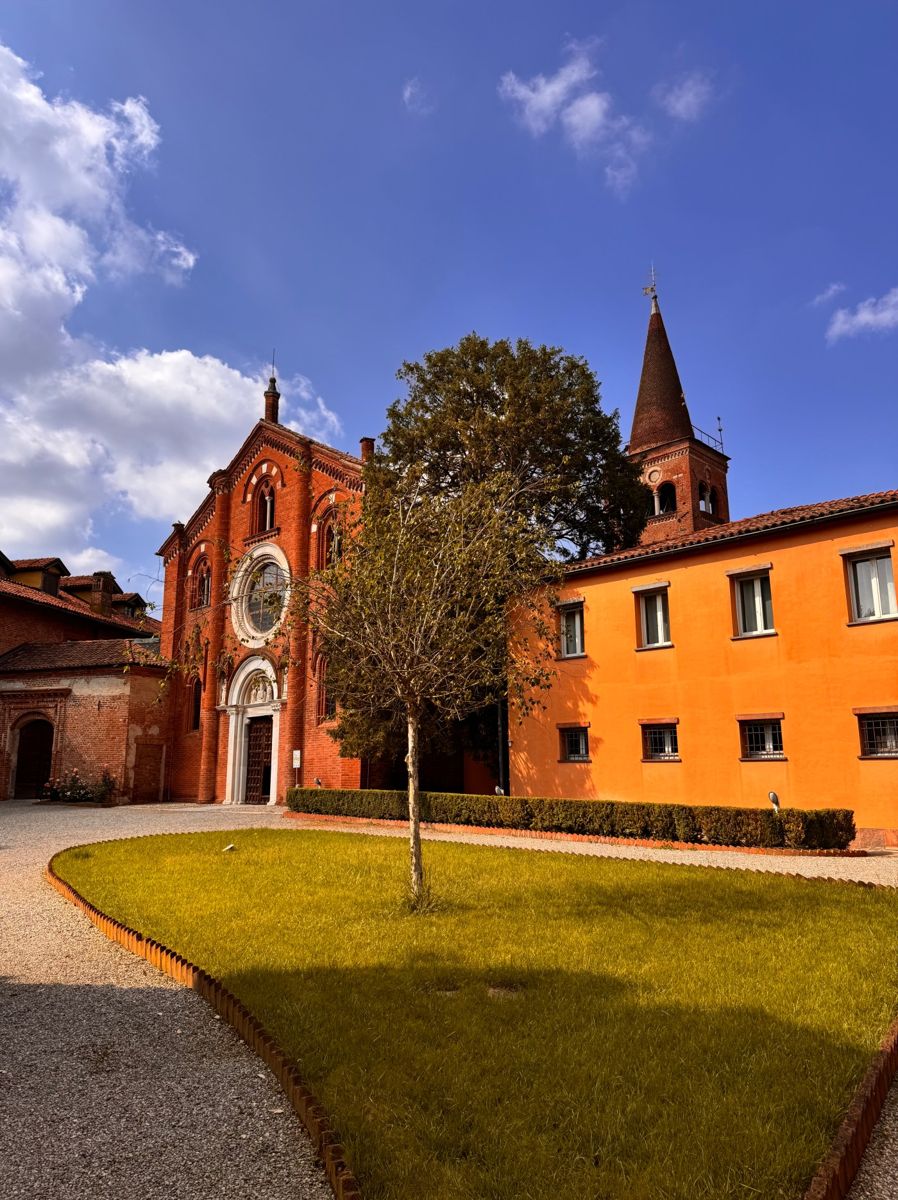
The Abbey of Viboldone stands as a stone testimony to the turbulent communal era of 12th-century Lombardy, when Milan, victorious in its struggle with Frederick Barbarossa that culminated in the Peace of Constance of 1183, was consolidating its territorial hegemony through intense building activity. Founded in 1176, in the aftermath of the Battle of Legnano, the abbey is not only a masterpiece of Lombard monastic architecture but also a symbol of the complex political and religious dynamics of northern Italy in the age of the communes.
The abbey complex, entrusted to the order of the Humiliati, belongs to the particular phenomenon of spiritual renewal which, from the Gregorian reform of the 11th century onwards, saw the proliferation of new religious orders in opposition to the temporal excesses of the Church. The Humiliati in particular emerged in the context of the poverty movements, some deemed heretical, that stirred Lombardy, finding a way back into Catholic orthodoxy thanks to Pope Innocent III, who officially recognised their rule with the bull "Cum dilecti filii" of 1201. The foundation of Viboldone falls precisely in this transitional phase for the order, when the Humiliati, initially suspected of heresy, were gradually brought within the official structures of the Church while keeping their characteristic blend of contemplative life and craft activity.
The choice of site, in the fertile plain south of Milan, along the ancient Via Emilia linking the Lombard capital with Lodi and Pavia, met precise economic and strategic needs. The area, recently reclaimed through the innovative hydraulic techniques that radically transformed the Lombard agricultural landscape between the 12th and 13th centuries, offered excellent opportunities for developing the farming and manufacturing activities typical of the Humiliati settlements. Proximity to the main roads also made it easy to market the abbey's products, in particular the fine woollen cloth whose manufacture was the order's main activity, earning them the nickname "friars of wool".
Culturally, the Abbey of Viboldone emerges as an expression of the particular synthesis between Lombard Romanesque tradition and new Gothic tendencies that characterised the architecture of northern Italy in the transitional period between the 12th and 13th centuries. Its construction coincides with other important works in the Milan area, such as the completion of Monza Cathedral and the start of work on the Basilica of Sant'Ambrogio in its present form, making it a key link in the evolution of the regional architectural language, influenced both by the Po Valley building tradition and by innovations from beyond the Alps filtered through the Cistercian experience.
Historical origins and territorial context
Located in the municipality of San Giuliano Milanese, a few kilometres from Milan, the Abbey of Viboldone was founded in 1176, although the present building dates mainly from between 1176 and 1348. The complex arose in a strategic area of the Po Valley, along the ancient road linking Milan with Lodi and Pavia, in a territory of intense agricultural activity that the Humiliati were able to develop and enhance.
The settlement of the Humiliati at Viboldone was a crucial moment for the economic development of the area. This religious order, born in the 12th century as a lay movement and later organised into regular communities, was distinguished by its particular combination of contemplative life and productive activity, devoting itself with special skill to wool working and to reclaiming the surrounding land. The abbey thus became not only a centre of prayer but also an important economic and cultural hub.
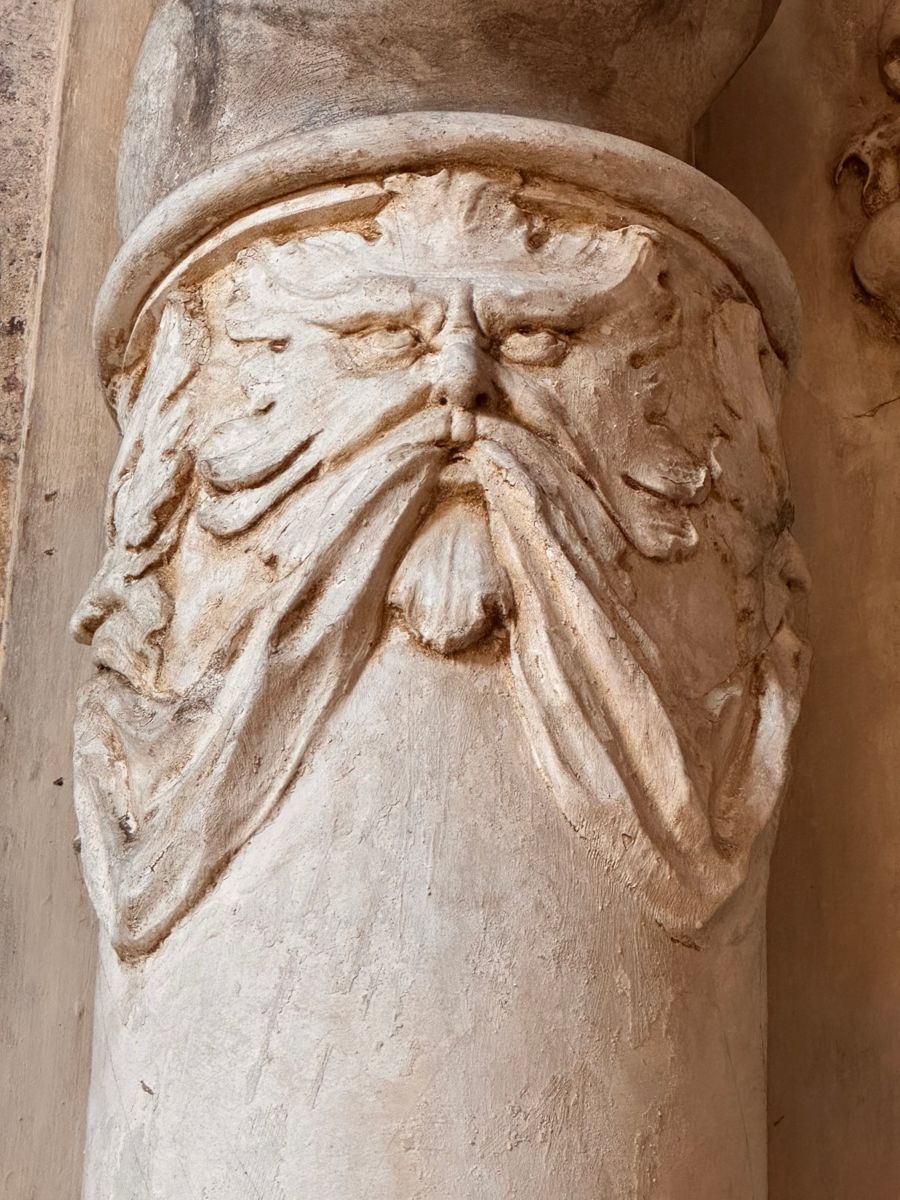
Architecture and stylistic features
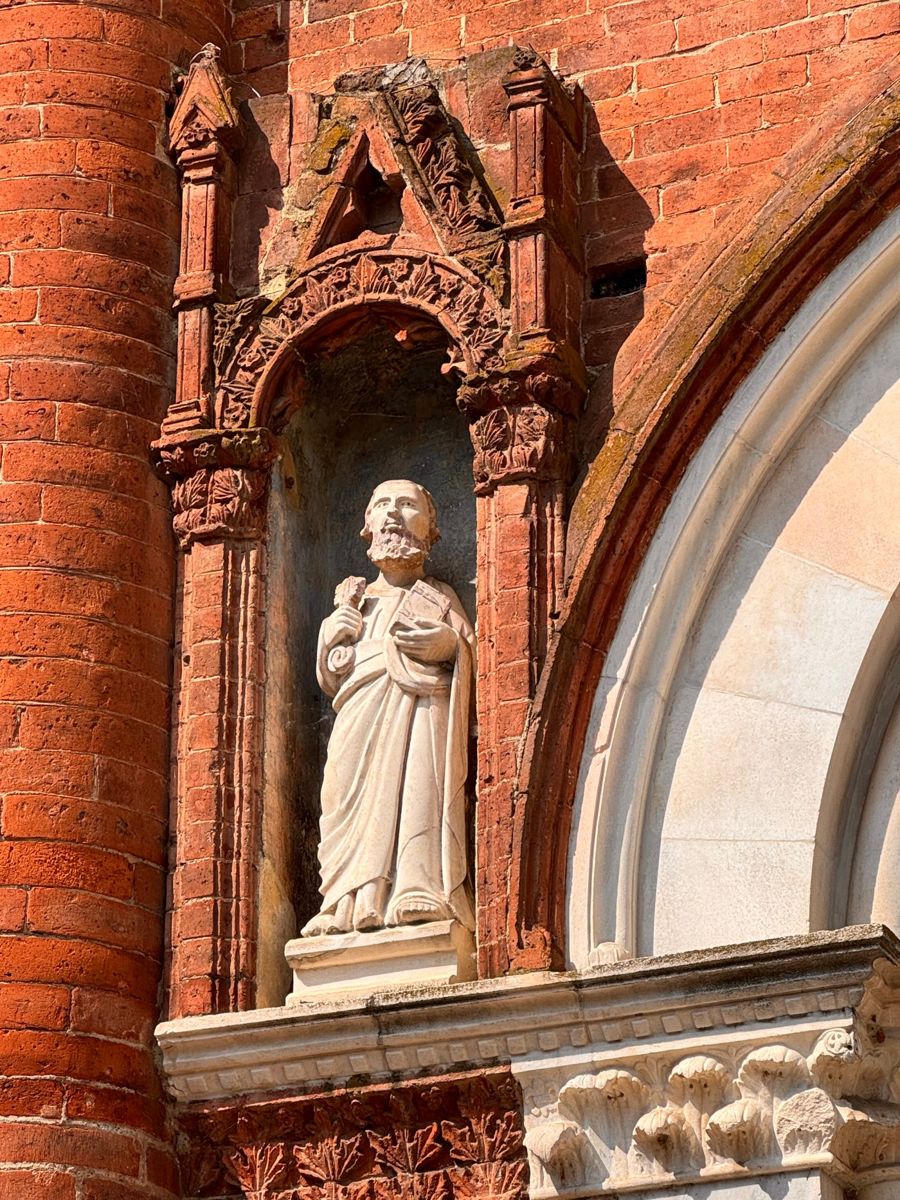
The abbey complex of Viboldone is an emblematic example of the stylistic transition between Lombard Romanesque and Gothic, with architectural solutions reflecting Cistercian influences reinterpreted according to local taste. The church, dedicated to Saint Peter, has a gabled terracotta façade, a material typical of Po Valley architecture, with a central portal surmounted by a rose window and a frieze of hanging arches dividing the wall surface horizontally.
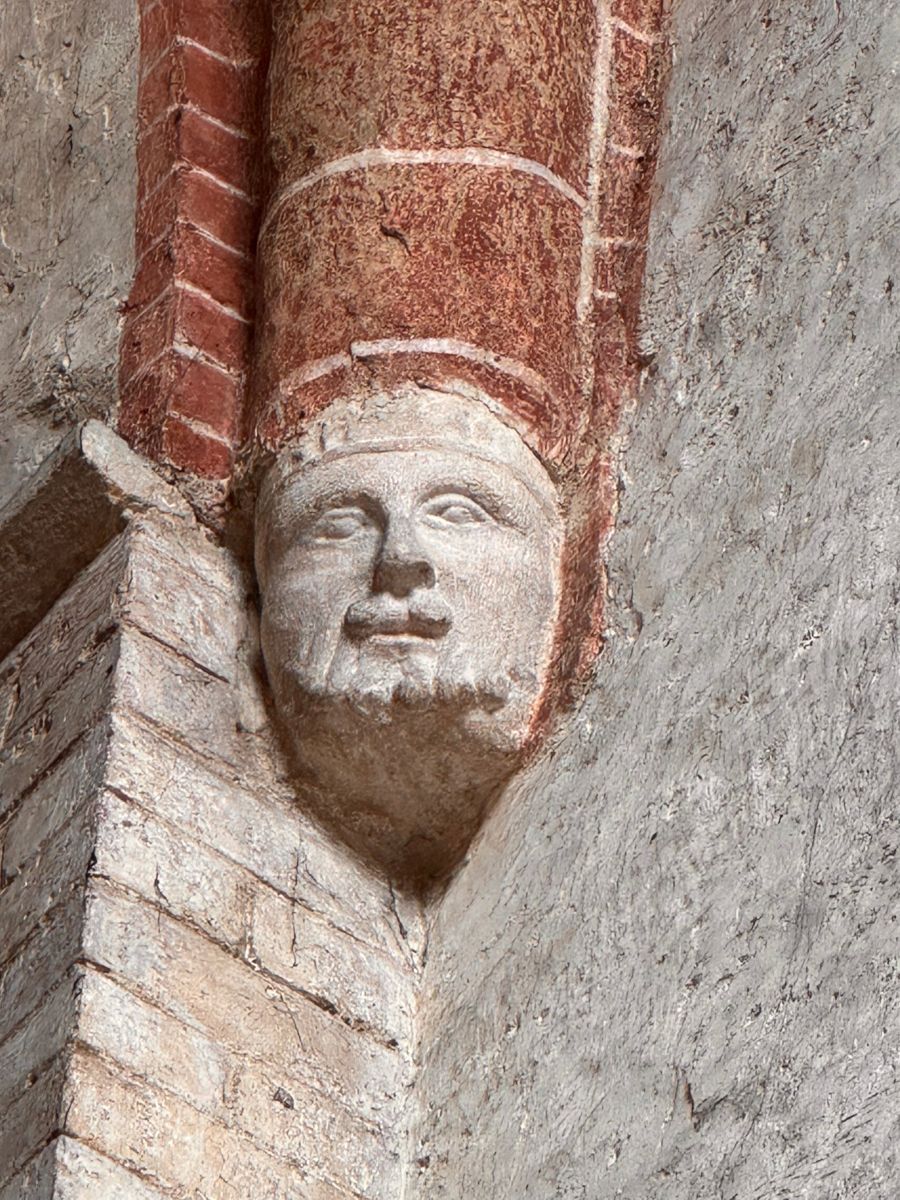
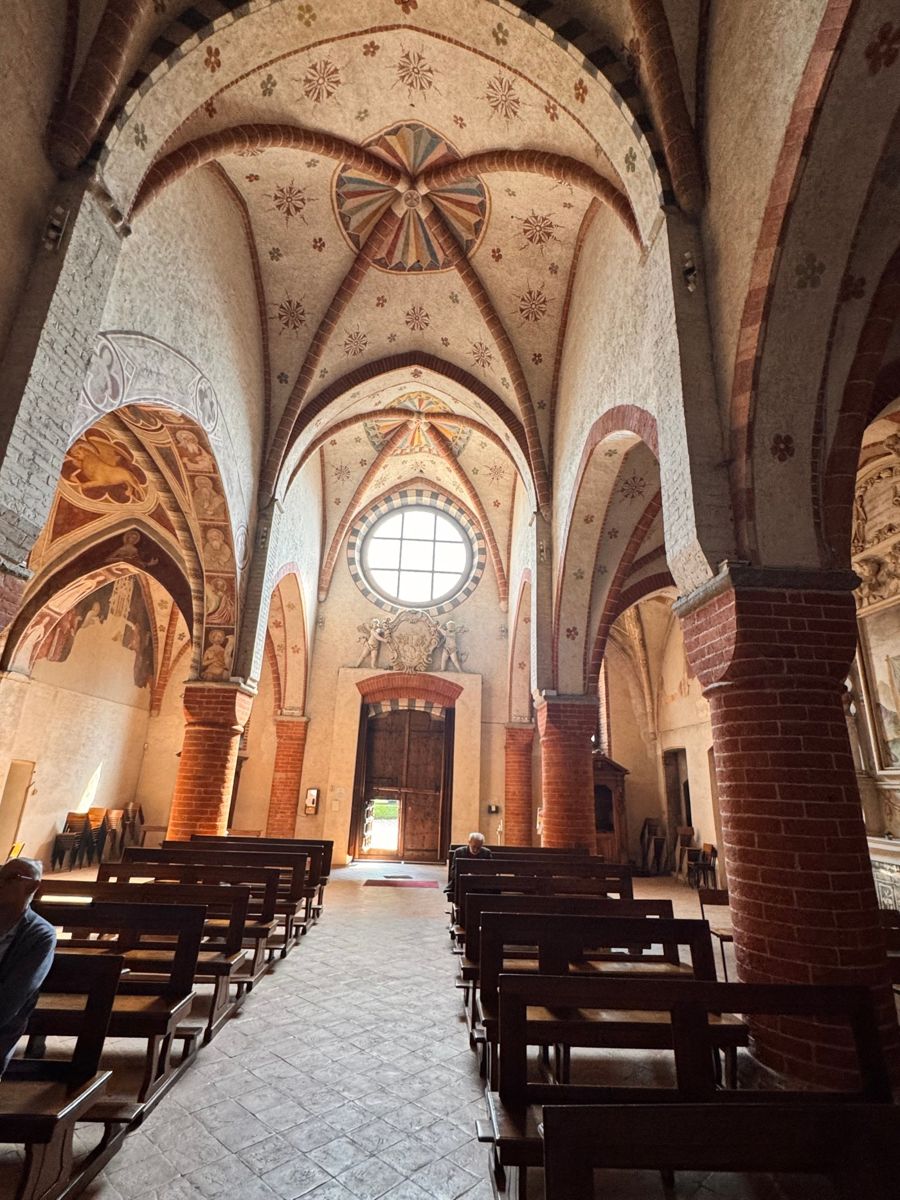
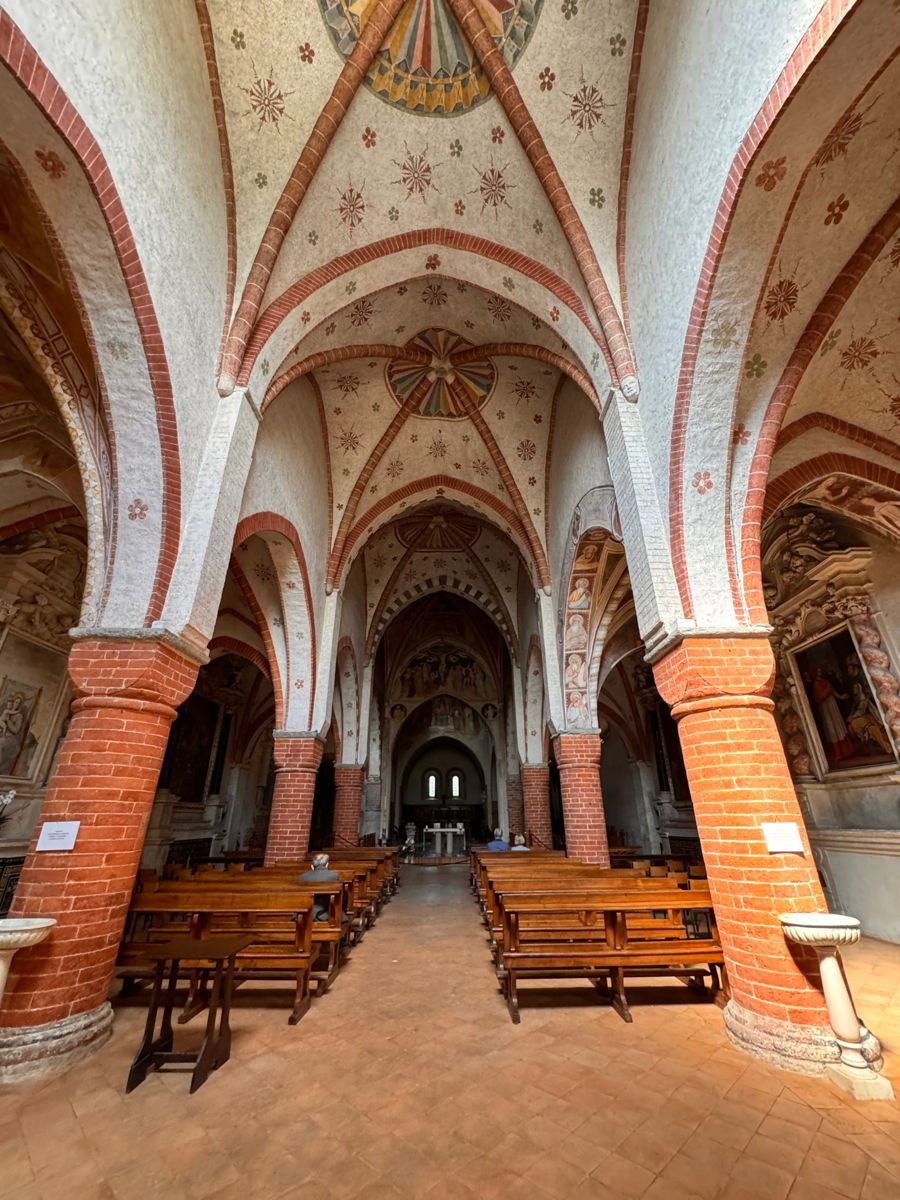
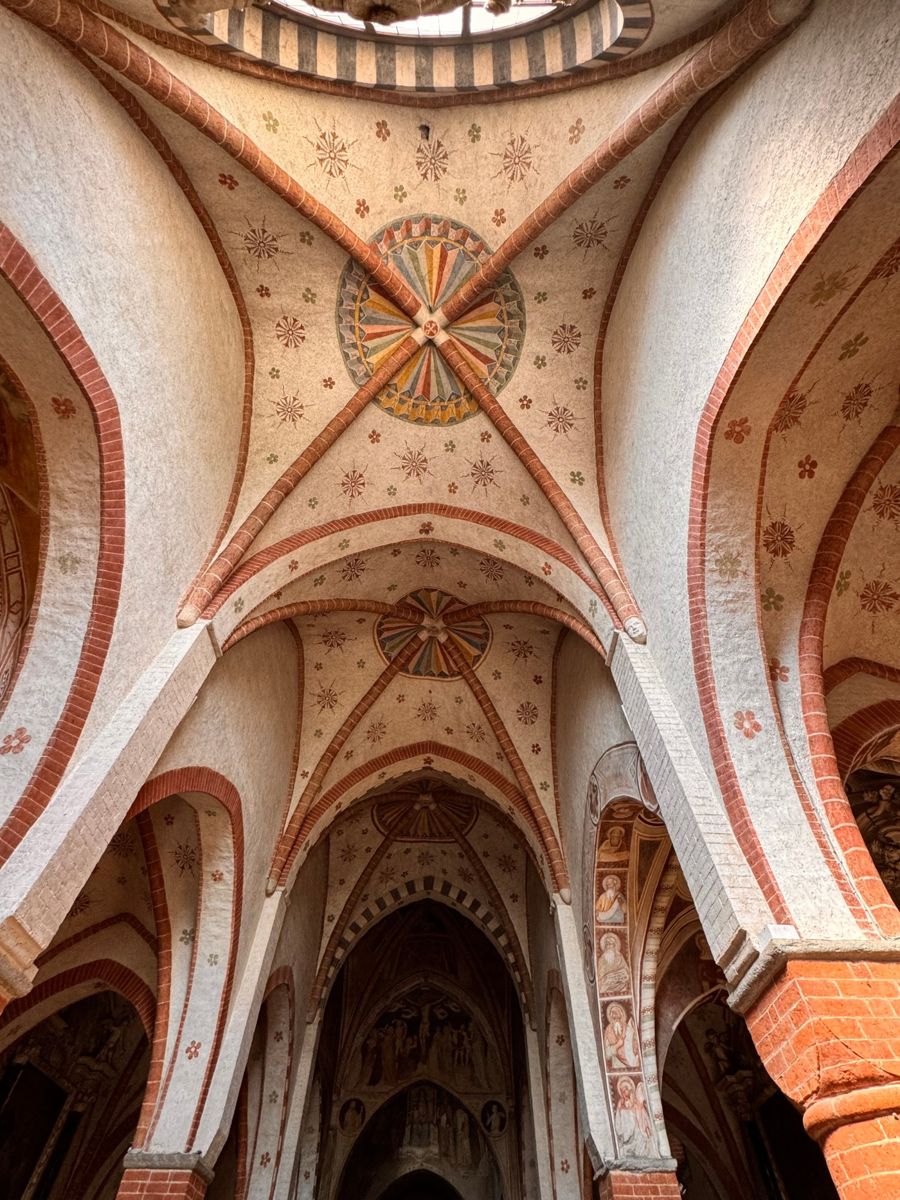
The plan comprises three aisles of different heights, the central one covered by ribbed cross vaults and ending in a square apse in accordance with the precepts of Cistercian architecture. Particularly significant is the roofing system, which shows the progressive assimilation of Gothic elements into the Lombard building tradition, with pointed arches supporting ribbed brick vaults.
The bell tower, rising on the south side of the building, becomes progressively lighter towards the top, with openings that grow wider and wider, a solution typical of Lombard Romanesque architecture.
Decoration
The most extraordinary feature of the Abbey of Viboldone is undoubtedly the fresco cycle decorating its interior, painted between 1349 and 1370. These paintings are among the most significant examples of 14th-century Lombard painting, showing the influence of the Giottesque school reworked according to local sensibilities.
The cycle, attributed to the workshop of the painters Giusto de' Menabuoi and Giovanni da Milano, is concentrated mainly in the presbytery and the apse. On the inner façade stands a monumental Last Judgement, with a rigorous spatial organisation and intense pathos in the figures of the damned and the blessed. The fresco reflects the circulation of Tuscan models in northern Italy, mediated by Giotto's stay in Padua.
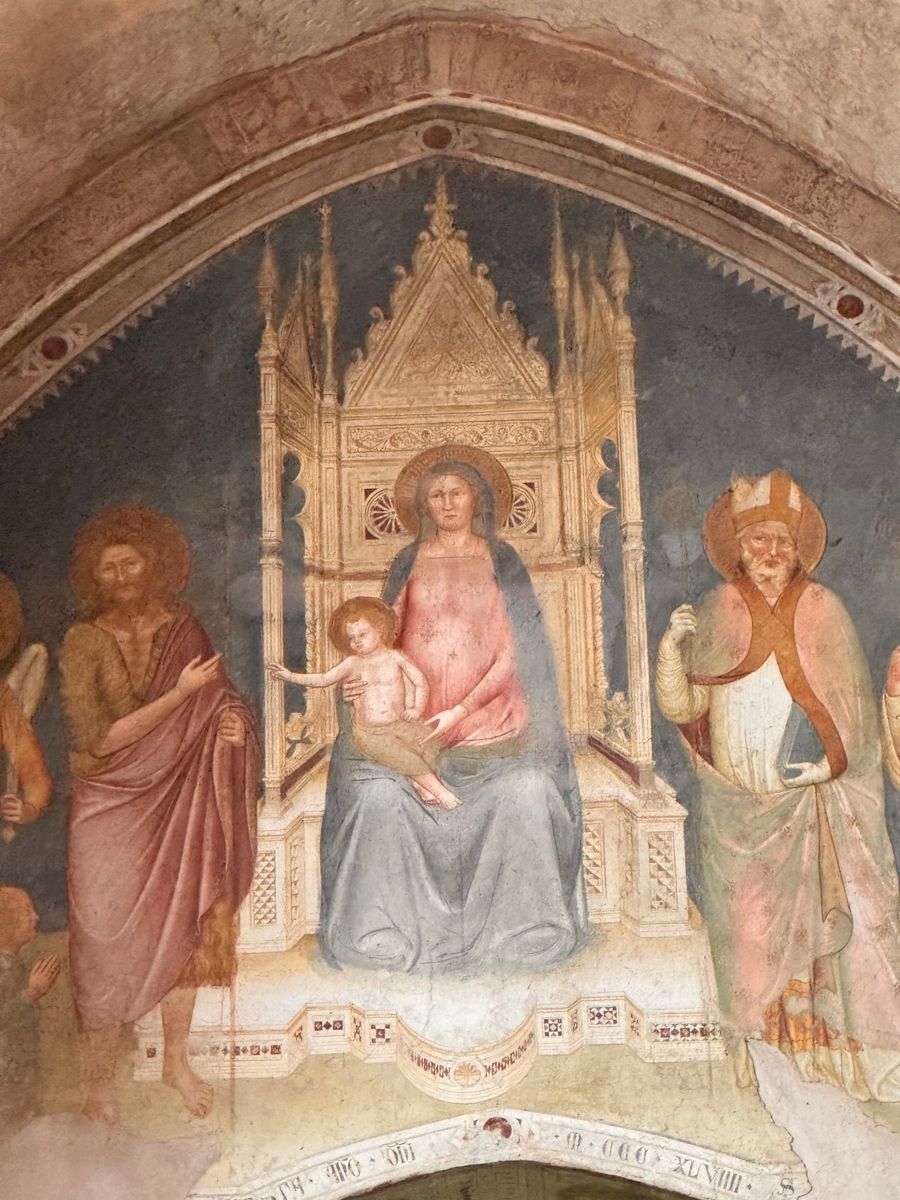
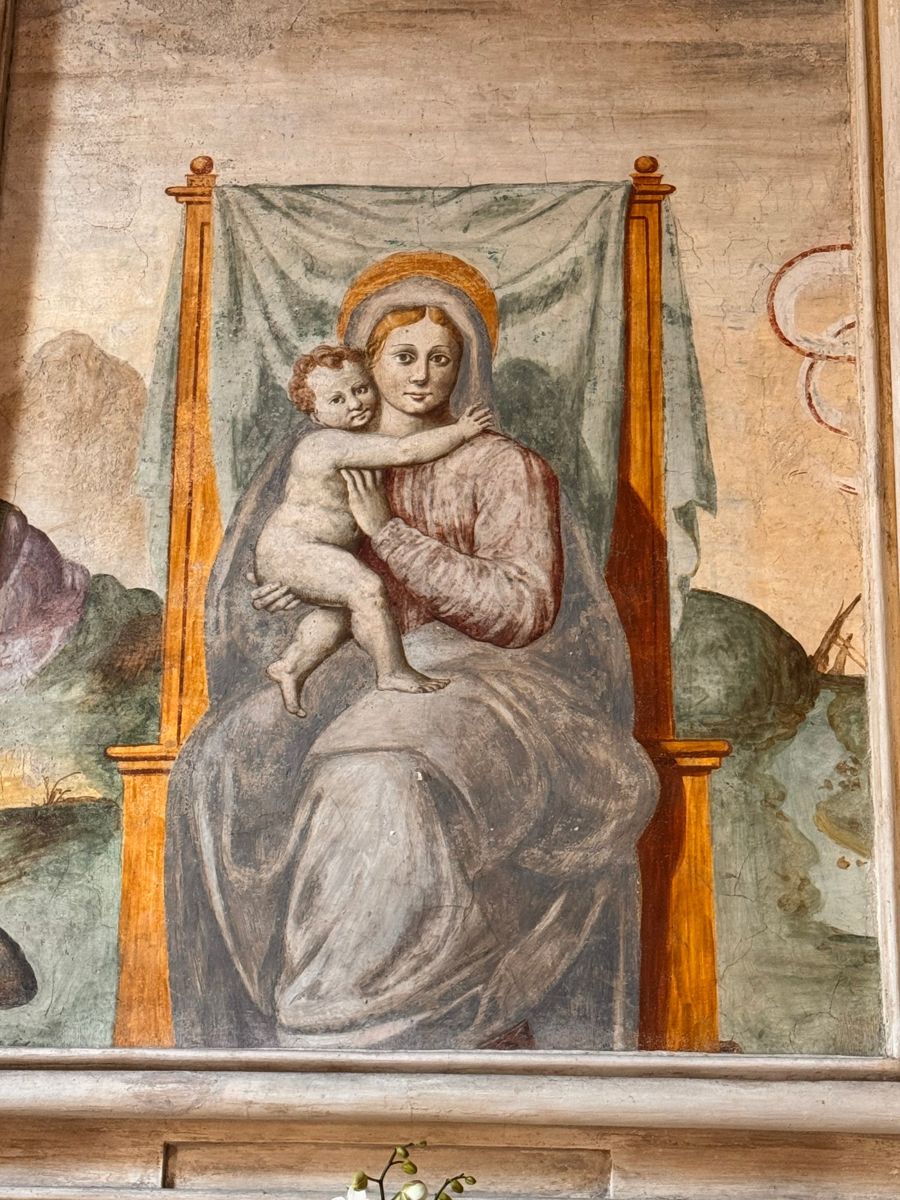
The depictions of the Crucifixion and of the Madonna Enthroned with Child are also of particular importance, showing a search for naturalism and expressive intensity that anticipates later developments in Lombard painting. The palette, dominated by intense and contrasting tones, lends drama to the sacred scenes, while the rendering of space, though influenced by Giotto, retains some of the two-dimensional character typical of the local figurative tradition.
Historical transformations and restoration
The history of the abbey was marked by changing fortunes that partly altered its appearance and use. With the suppression of the Humiliati order in 1571, decreed by Pope Pius V following episodes of corruption and moral laxity, the complex passed under the jurisdiction of the Ospedale Maggiore of Milan. This led to a gradual transformation of the monastic spaces, which were adapted for agricultural and productive purposes.
Over the following centuries the abbey underwent alterations that partly changed its original appearance. Only from the end of the 19th century, with the recognition of its historical and artistic value, did the first conservation work begin, culminating in the restoration campaign promoted by the Soprintendenza ai Monumenti of Milan in the 1950s.
This work restored the original spatial quality of the church and enhanced its decoration, removing the later additions and alterations that had compromised its perception. Particularly significant was the restoration of the 14th-century frescoes, which made legible again a pictorial cycle of extraordinary importance for understanding the development of 14th-century Lombard painting.
The Abbey in the context of Lombard art
The Abbey of Viboldone occupies a pivotal point in the evolution of Lombard religious architecture, representing a moment of synthesis between local Romanesque tradition and the new Gothic tendencies spreading through northern Europe. Its decoration is also fundamental evidence for understanding the circulation of figurative models between Tuscany and Lombardy during the 14th century.
The particular architectural solution adopted at Viboldone, blending Cistercian elements with the Lombard building idiom, influenced many religious buildings in the surrounding area and became a reference model for monastic architecture in the region. At the same time, the frescoes painted by the workshop of Giusto de' Menabuoi and Giovanni da Milano helped spread a figurative language which, while keeping links with the Byzantine-influenced tradition, opened up to the spatial and naturalistic innovations of Tuscan painting.
Contemporary cultural value
Today the Abbey of Viboldone is not only a monument of extraordinary historical and artistic value but also an active spiritual and cultural centre. Since 1941 the complex has been home to a community of Benedictine nuns who have revived the site's ancient contemplative tradition, combining it with book restoration and craft production.
The presence of this monastic community has helped to promote the abbey as a meeting place for spirituality, art and culture, encouraging study and research on the complex's artistic heritage. The abbey is also included in the main cultural tourism itineraries of Lombardy and is an essential stop for understanding the medieval art of the Milan area.
Conclusions
The Abbey of Viboldone is a paradigmatic example of the cultural and artistic complexity of the Lombard Middle Ages, showing a capacity to absorb and rework architectural and figurative models from different contexts. Its extraordinary structural integrity and the quality of its decoration make it a monument of primary importance in the Italian artistic panorama, deserving of further study.
The continuing rediscovery of this jewel of Lombard Cistercian-influenced architecture is not only a contribution to historical and artistic knowledge but also an opportunity to enhance a cultural heritage that continues to speak to the present, offering food for thought on the relationship between spirituality, art and territory.
Bibliography
Arslan, E. (1954). L'architettura romanica milanese. Milan: Edizioni dell'Arte.
Beltrami, L. (1912). Storia della Certosa di Pavia e l'Abbazia di Viboldone. Milan: Hoepli.
Bertelli, C. (1985). La pittura lombarda del Trecento. In La pittura in Italia. Il Duecento e il Trecento (pp. 56-89). Milan: Electa.
Bottoni, P. (1963). Antiche abbazie lombarde. Milan: Görlich.
Castelfranchi Vegas, L. (1985). L'arte del Quattrocento in Lombardia. Milan: Jaca Book.
Chierici, G. (1942). L'architettura romanica in Lombardia. Milan: Bocca.
Di Carpegna, N. (1960). Gli affreschi trecenteschi dell'Abbazia di Viboldone. Milan: Arte Lombarda.
Ferrari, M. L. (1982). Gli Umiliati, l'Abbazia di Viboldone e il restauro del ciclo degli affreschi. Milan: Silvana Editoriale.
Mazzini, F. (1967). Affreschi lombardi del Trecento. Milan: Silvana Editoriale.
Porter, A. K. (1915-1917). Lombard Architecture. New Haven: Yale University Press.
Romanini, A. M. (1964). L'architettura gotica in Lombardia. Milan: Ceschina.
Rossi, M. (1995). Disegno storico dell'arte lombarda. Milan: Vita e Pensiero.
Salmi, M. (1955). La pittura e la miniatura gotica in Lombardia. In Storia di Milan (Vol. V, pp. 812-874). Milan: Fondazione Treccani degli Alfieri.
Schofield, R. (1989). Architettura religiosa a Milan nel Quattrocento. In Storia di Milan (Vol. VI, pp. 645-711). Milan: Fondazione Treccani degli Alfieri.
Verga, E. (1931). Storia della vita milanese. Milan: Libreria Milanese.
Originally published in Italian on the Montezaga blog (montezaga.wordpress.com) →