The Sunday Christ: Iconographic Analysis and Regional Variants
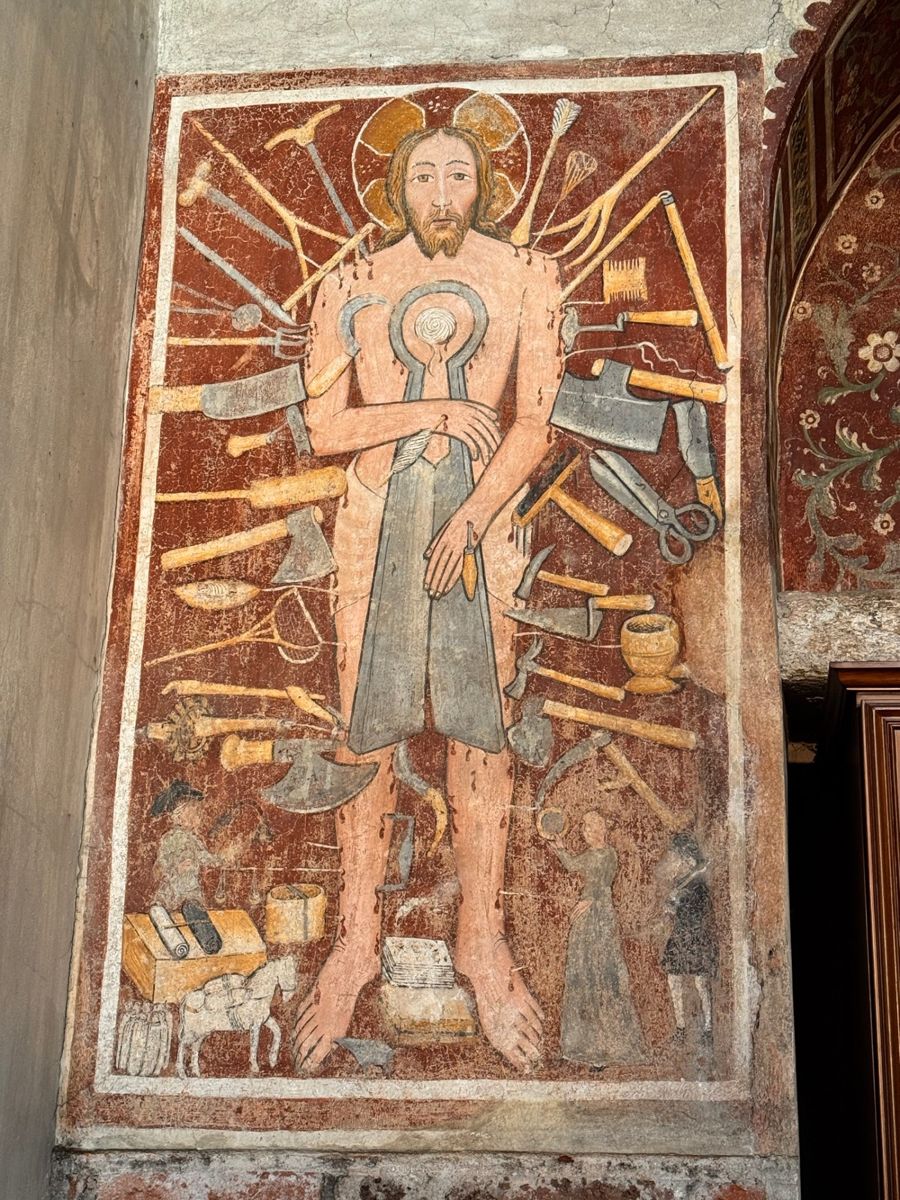
The "Sunday Christ" (Cristo della Domenica) is an artistic and religious figure of great interest, found mainly between the 14th and 16th centuries in the Alpine area of northern Italy and in parts of central Europe. Its iconography is a moral and spiritual warning to the faithful, intended to stress the respect due to the day of rest, Sunday, and to warn against working on feast days.
Origin and Meaning
The Sunday Christ depicts a suffering, wounded Christ, almost always half-naked and with his hands pierced, portrayed to convey the sacrifice he made and divine condemnation for those who break the religious precept of Sunday rest. The iconography became established as a warning against working on feast days, with episodes showing ordinary people (peasants, craftsmen, servants) engaged in forbidden activities and often threatened by demons. The image thus had a teaching and social-control function, rooted in the religious and cultural tradition of the time.
Regional Variants
The spread of the Sunday Christ gave rise to regional iconographic variants reflecting different cultural, economic and religious traditions.
Northern Italy and the Alpine area
In northern Italy, particularly in the Alpine valleys, Trentino and Lombardy, Christ is shown standing in a loincloth, his body marked by the wounds of the Passion. Typically, human figures embody forbidden Sunday work, with farming tools, smith's tools or household implements symbolising the breach of the feast-day precept. Little devils or infernal figures threatening the workers often appear as well. The natural setting reflects the Alpine environment, with mountains and rural landscapes that give context to the message.
These images were common in rural places of worship and represented a clear religious and social warning.
Central Europe (Austria, Germany, Switzerland, Slovenia)
Here the iconography has similar features, with Christ interpreted as a symbol of the Passion and martyrdom for the sake of Sunday rest. The depictions often include the cross and prominent wounds, with the tools of work typical of the area pointed at Christ's body or placed at his feet. The tradition, also known as the "Feiertagschristus", is widespread throughout the Alpine region, with clear references to the rural and craft work forbidden on feast days.
Central and Southern Italy
In central and southern Italy the Sunday Christ is rarer and less clearly defined. The depictions tend to be closer to the traditional iconography of the Passion, with less emphasis on episodes of forbidden work. A few examples in Emilia and neighbouring areas show elements linked to daily and community life around Christ, but without the strong admonitory charge typical of the North.
Common Iconography
Despite the variants, there are common iconographic elements:
- A suffering Christ, half-naked in a loincloth, often with evident wounds of the Passion.
- Figures representing forbidden Sunday work, often shown around or near Christ.
- Symbols of punishment or infernal threats towards transgressors.
- Scenes conveying the message of feast-day rest as a moral and religious duty.
- Christ as the focus of attention, the centre of visual and religious communication.
The Church's judgement on the iconography of the Sunday Christ
Despite the communicative and religious value of these images, the iconography of the Sunday Christ did not spread more widely, partly because of the Catholic Church's critical judgement. Many of these depictions were considered ambiguous or heretical because they emphasised a moralistic and punitive message rather than a redemptive one, showing Christ almost as a severe, immediate judge punishing those who broke the Sunday precept.
The Church feared that this depiction shifted attention from Christ's mercy to a vision based on fear, fostering superstition and social control rather than authentic faith. The images, which often also showed devils and infernal punishments for those who worked on Sunday, were seen as disrespectful and vulgar, leading gradually to their removal or replacement, especially after the Council of Trent, which imposed strict rules on sacred iconography.
This ecclesiastical judgement explains the rarity of these images and the regional differences, since they often survived only where church control was less strict or where parish priests continued to use them as a visual warning to the people.
Bibliography
- Gloria Riva, “[L'iconografia del cosiddetto Cristo della domenica]”, Gli Scritti.
- “Il Cristo della Domenica”, Progetto Storia dell'Arte, 2022.
- “Cristo della Domenica”, Wikipedia, 2019.
- Stefano Chiappalone, “Il Cristo della Domenica”, Alleanza Cattolica, 2022.
- “Il Cristo della Domenica: un'iconografia tra arte e religione. Un esempio vicentino”, Academia.edu, 2015.
- “La strana iconografia del Cristo della Domenica. Chi lavora va all'inferno”, Restaurars, Altervista.org.
- “Il ‘Martire’ di Capriati, un Cristo della Domenica”, Academia.edu.
These sources provide a historical, artistic and theological overview of this unusual iconography and of the role of moral control this figure played in Christian traditions, with particular reference to its repression by the Catholic Church.
Sources
[1] Il Cristo della Domenica https://alleanzacattolica.org/il-cristo-della-domenica/
[2] senza fatica non c'è senso della vita. Dal Cristo signore … http://www.gliscritti.it/blog/entry/5998
[3] Il settimo giorno si riposò: il “Cristo della domenica” si … https://www.messaggeroveneto.it/cultura-e-spettacoli/il-settimo-giorno-si-riposo-il-cristo-della-domenica-si-conserva-a-pordenone-wl67ylhr
[4] Il Cristo della Domenica https://teafonzi.it/il-cristo-della-domenica/
[5] IL “CRISTO DELLA DOMENICA” - Progetto Storia dell'Arte https://www.progettostoriadellarte.it/2022/11/21/il-cristo-della-domenica/
[6] Il Cristo della domenica Cosa rappresenta il … https://www.facebook.com/Fabio.the.bull/posts/il-cristo-della-domenica-cosa-rappresenta-il-cristo-della-domenicasi-tratta-di-u/10226692790768662/
[7] Cristo della domenica - I quadri che minacciano l'inferno a … https://www.stilearte.it/cristo-della-domenica-i-quadri-che-minacciano-linferno-a-chi-lavora-nei-giorni-di-festa/
[8] Il Cristo della Domenica alla Pieve di Feletto https://www.sharry.land/it/meraviglie/il-cristo-della-domenica-alla-pieve-di-feletto
[9] http://www.corriere.it/cronache/09_marzo_31/artico… http://www.corriere.it/cronache/09_marzo_31/articolo_chiesa_92_dc8d7830-1dd6-11de-84d3-00144f02aabc_print.html
[10] San Pietro di Feletto - colli trevigiani strada del vino prosecco https://www.magicoveneto.it/trevisan/feletto/colli-felettani-cristo-della-domenica-san-pietro-di-feletto.htm
Originally published in Italian on the Montezaga blog (montezaga.wordpress.com) →