The Oratory of San Pellegrino in Bominaco
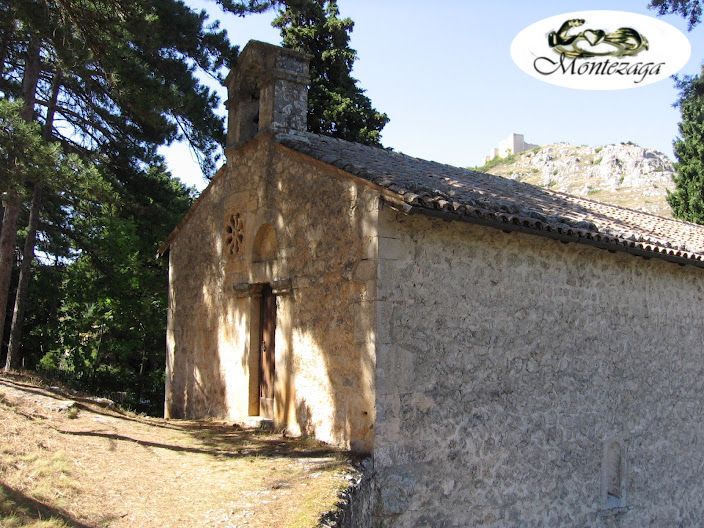 From the Navelli plateau, at about 1,000 metres above sea level, the Oratory of San Pellegrino and the Church of Santa Maria Assunta overlook the Via Appulo Sannitica, better known as the SS17 state road, which links the cities of Foggia and L'Aquila. From here you enjoy a view worthy of a falcon in flight, and the pleasant breeze rising from the valley refreshes the overheated visitor on the sunniest summer days. The two churches were originally part of a single Benedictine monastic complex in the municipality of Bominaco, once known as Momenaco. The origins of the complex date back to the 3rd–4th century, when a lay missionary, Saint Pellegrino, who had come to Italy from Syria, was martyred. A small shrine was first built on the site of his burial, followed by a church in the 8th century. Charlemagne too was linked to the history of this holy place: he gave the church 500 modii (about 170 hectares) of land and placed it under the protection of the Abbey of Farfa. From then on the Benedictine community flourished together with the local people, who were involved in the friars' many activities. Thanks to the friars' knowledge, real agricultural estates with commercial distribution hubs were set up in the area, and the arts flourished. In 1001 the monastery became independent of Farfa, and between the late 11th and early 12th centuries the abbey church of Santa Maria Assunta was built within the complex. In 1423 the monastery was not spared by the war unleashed by the condottiero Braccio da Montone, who seriously threatened the Papal States. Out of gratitude to the nobility of L'Aquila, who had halted the condottiero's advance by putting an end to his life, the Pope granted patronage over the abbey of Bominaco to the Count of Forfona. He was also granted the right to appoint the abbot. This upset the monastic order, since the abbot, Father and Teacher, had always been elected by the monastic community itself. The monks therefore abandoned Bominaco in the early 1500s; where they went is still unknown. And so the Roman Curia took possession of the wealth generated by the monks. Over time the abbeys that were "acquired" became, for the Papal States, rich benefices to be granted to dignitaries of the upper church hierarchy, mostly cardinals. In 1750 a bull of Benedict XIV turned the abbey of Bominaco into a simple parish under the jurisdiction of the bishop of L'Aquila.
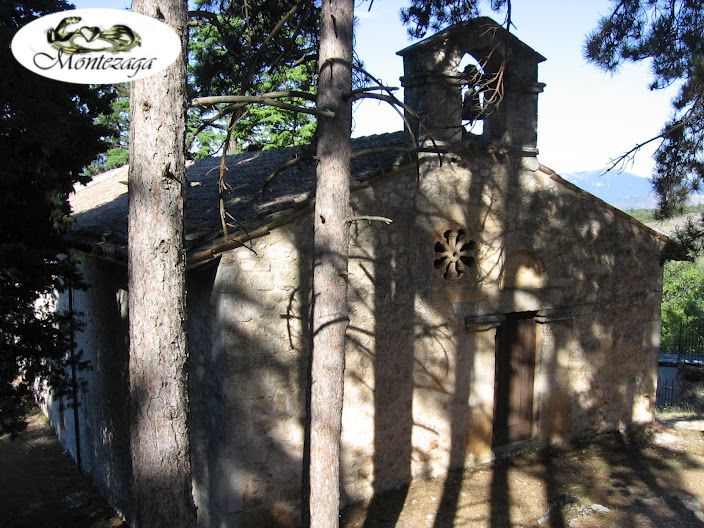
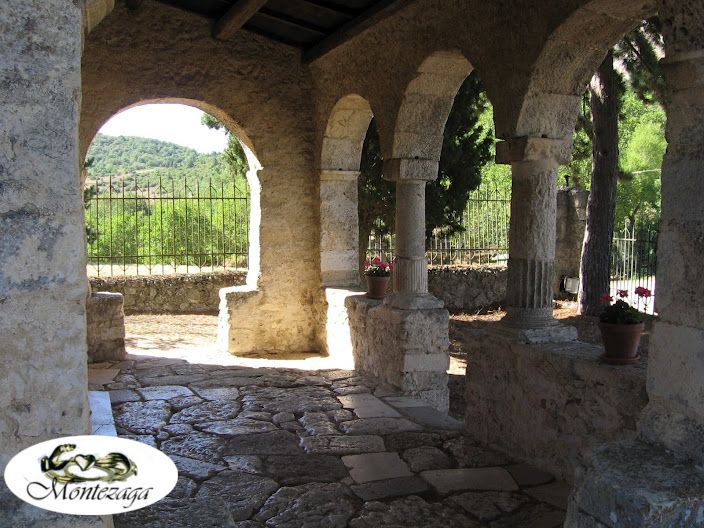
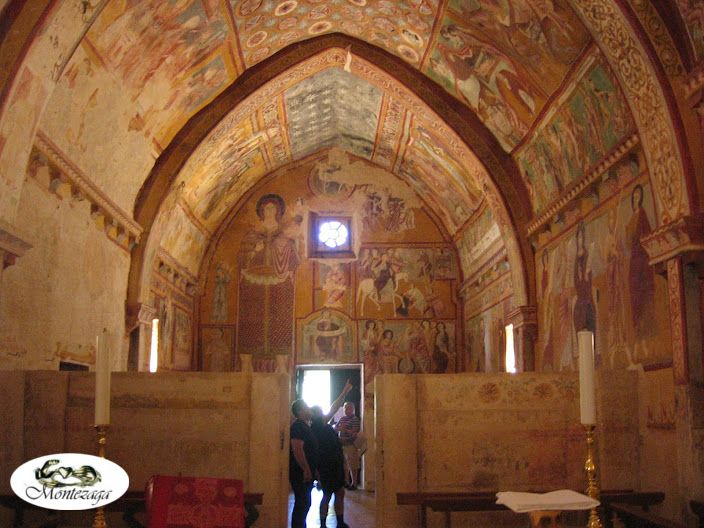
Although the exterior of the Oratory of San Pellegrino is austere in its simplicity, on entering, visitors find themselves immersed in a frescoed, many-coloured universe that envelops them and leaves them astonished. The frescoes cover both the side walls and the vaults of the roof without interruption. Many subjects are depicted, following the life of Jesus Christ as a narrative thread: the Annunciation, the Nativity, the Presentation of Jesus in the Temple, the triumphal entry into Jerusalem on Palm Sunday, the Last Supper, the Washing of the Feet, the betrayal of Judas, the Deposition and the burial of Christ. The scenes of the Crucifixion and the Resurrection, however, are not depicted. It is hard to believe this was an oversight...
But the frescoes that strike us most are those that are generally not given prominence, perhaps because they are "embarrassing" for a Catholic church. We have already dealt with one of them in our post on Saint Christopher. Besides the alchemical symbolism of the saint's figure, we should recall his link with the Egyptian god Anubis, depicted with a man's body and a dog's head and guardian of the world of the dead. In the Middle Ages the cult of Saint Christopher was widespread in both East and West. In the West the saint's feast was celebrated on 25 July (in 1969, however, the Church removed the celebration from the calendar of saints). His feast fell during the dog days, the period from 25 July to 26 August, when Sirius, the brilliant star of the constellation Canis Major, had its heliacal rising. This is why the saint was depicted in Byzantine iconography as a Cynocephalus (dog-headed) saint. In France and Germany it was customary on 25 July to sacrifice a cockerel to Saint Christopher, just as, according to Plutarch, it was customary in Egypt to do for Anubis. In ancient depictions Saint Christopher was also painted wearing a richly decorated garment, with a cloak and belt, holding a palm frond or an uprooted tree, the last two elements also typical of depictions of Anubis. That images of the saint are simply a Christianisation of images of the Egyptian god is further attested by the fact that statues of the saint were often placed at church entrances as guardians, just as Anubis was guardian of the underworld.
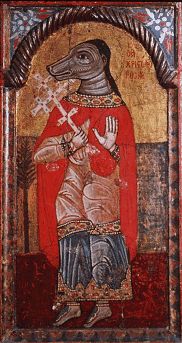
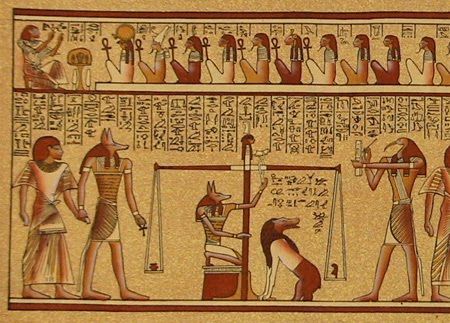
In our Oratory at Bominaco the figure of the saint is on the entrance wall, immediately to the right of the portal. Here his link with the Egyptian god appears to be reinforced by another depiction on the right-hand wall of the church, near the entrance: the Psychostasia, the ancient rite of the weighing of souls.
The term Psychostasia refers to the ceremony, depicted in the Book of the Dead of ancient Egyptian religion, that the deceased had to undergo before entering the afterlife. In the ceremony the deceased is led by Anubis before the judges. Anubis also carries out the actual weighing of the deceased's heart, represented by a jar placed on one pan of the scales, while on the opposite pan is placed Maat (justice), represented by a feather. Thoth, god of wisdom, records the result of the weighing in his "Book of Life". If the heart, a kind of "black box" of the deeds done in life, balances the feather, the deceased is declared "just" and admitted to the kingdom of the dead. Otherwise the heart is fed to Ammit, crouching at the foot of the scales, a composite creature depicted with the head of a crocodile, the forequarters of a lion and the hindquarters of a hippopotamus. At the end of the rite the "just" deceased is presented by Horus to Osiris, god of the underworld.
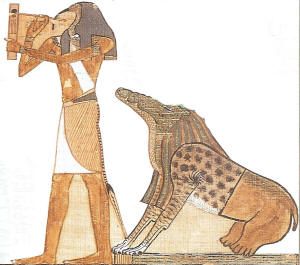
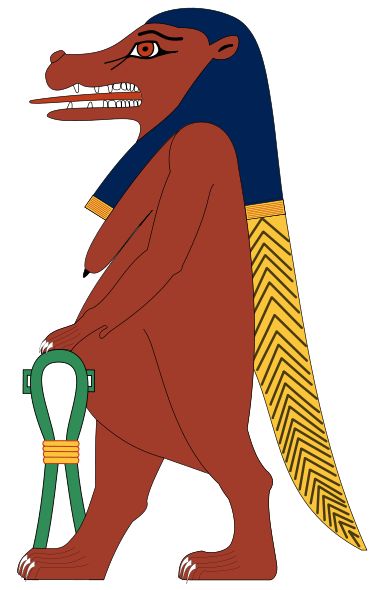
The scholar Adrian Gilbert gives us a somewhat different interpretation of the rite of the weighing of souls. According to Gilbert the rite took place inside the Great Pyramid, in the King's Chamber. Depending on the result of the weighing, the soul of the dead could leave the earth and join Osiris in the celestial world, or be swallowed, not by the monster Ammit, but by the goddess Taweret, who also had a rather unsettling appearance, very similar to Ammit, with the head of a crocodile and the body of a lion. A still unexplained feature of the famous King's Chamber is the presence of two shafts, so called because they were thought to serve for ventilation. In fact these shafts seem to be celestial pointers: one directed south, which at the time the pyramid was built pointed to the culmination point of the star Al-Nitak in Orion's Belt, while the other was aimed at the pole star of the time, Alpha Draconis. While Osiris is associated with the constellation of Orion, which therefore represents paradise, the Pole Star is symbolised by the goddess Taweret. There were thus two possible destinies for the soul: to join Osiris in the afterlife, or to be devoured by Taweret in order to be reborn on earth. The goddess was always depicted in an advanced state of pregnancy, as she was also considered the protective deity of pregnant women. Reincarnation was therefore seen as a second chance to try once again to earn paradise. This interpretation would make the Egyptian cult similar to Eastern religions, but also to Gnostic Christian belief. In the Bominaco oratory the rite of the "weighing of souls" is not depicted in Egyptian terms but as it was represented in the Middle Ages, as we can see from the few examples still visible today. Often, when churches were renovated, some frescoes were covered by new ones more in keeping with the dictates of the prevailing creed.
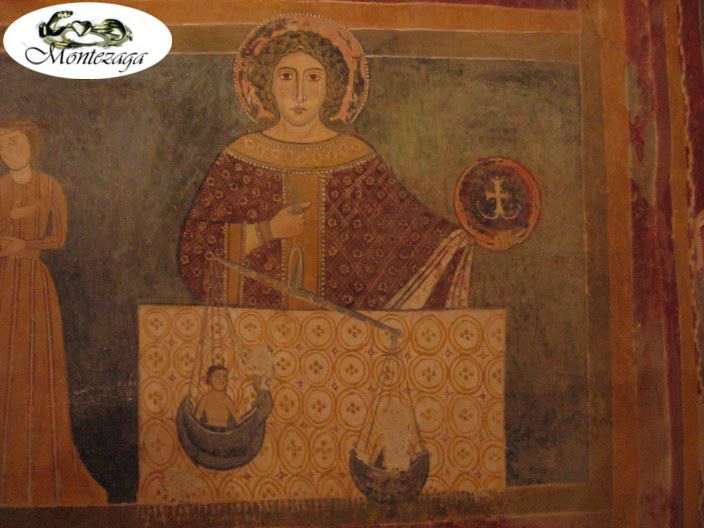
Here the one presiding over the weighing is Saint Michael, who holds the scales. On the two pans are the souls being judged, depicted as little men aboard a ship, as the presence of a figurehead shows. (One face has been scratched out: perhaps someone did not like resembling a damned soul.) Saint Michael, the alter ego of Thoth, holds the scales in one hand and in the other a globe bearing a cross whose lower end has a double hook (an anchor cross). In Byzantine icons Saint Michael is generally depicted with a serious expression, large elongated eyes and very rich garments, like those of emperors, holding the globe or the scales. What is striking about this depiction is how clearly the double-hooked cross recalls another cross-shaped symbol with a dualistic meaning: Abraxas.
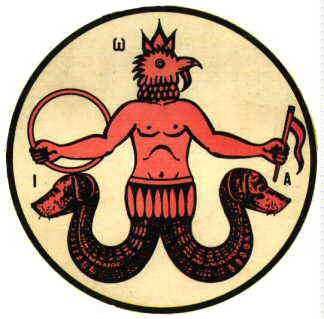
This was the name the Gnostics gave to the Supreme Aeon, the reconciliation of Good and Evil, the creator god of the divine world. This god was distinct from the God of the Bible, who for the Gnostics had merely created the imperfect material world, as the Demiurge. Abraxas is in fact mentioned in the Nag Hammadi papyri, direct sources of ancient Gnosticism. This represents a tangible link of cultural descent between the Benedictine order and the cenobitic monasticism of Saint Pachomius, an Egyptian monk and former soldier who lived between the 3rd and 4th centuries. Let us remember that the Nag Hammadi papyri contain what escaped the destructive fury of Catholicism: the Gnostic Gospels and other writings belonging to the Corpus Hermeticum. There are precisely 13 papyri, found in 1945 in an earthenware jar by shepherds from the village of al-Qasr, near a Pachomian cenobitic monastery at Nag Hammadi. The monks had probably hidden them to prevent their destruction when Gnosticism was judged a heresy by the nascent Catholic Church. Let us also remember that cenobitic monasticism was spread in the West by Saint Benedict of Norcia, thanks in part to his meeting with Abbot Servandus, bearer of the Pachomian rule, at the Protocenobium of San Sebastiano in Alatri.
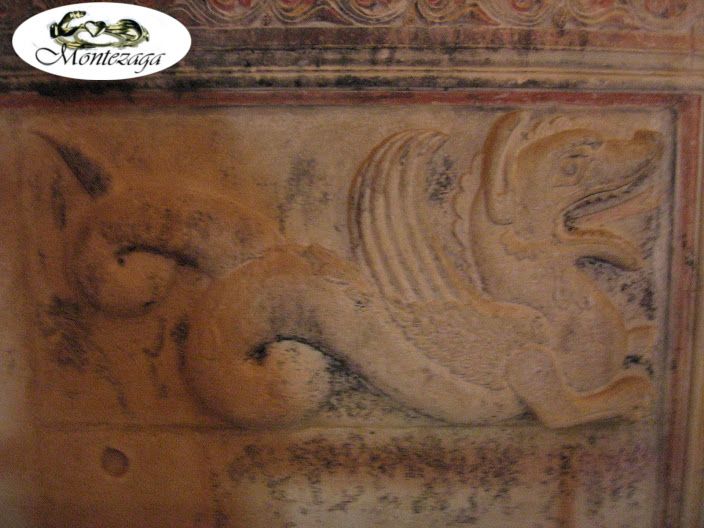
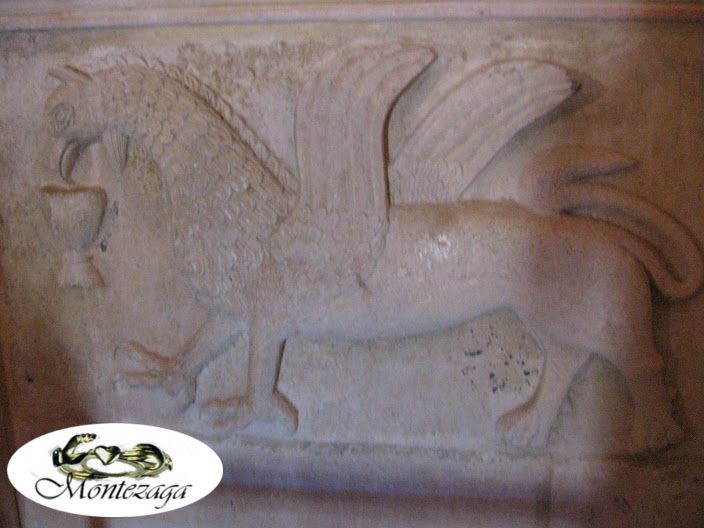
As vertical elements dividing the nave we find two plutei (carved panels) side by side, the right one depicting a wyvern and the left one a griffin; together they formed the partition between the baptised and the catechumens.
The griffin is a fabulous monster with the head, wings and talons of an eagle and the body and hind legs of a lion. The iconographic theme originated in Mesopotamia and Egypt around 3000 BC. Often found as a decorative motif in the art of ancient Persia, the griffin became for the Hebrews the symbol of the Persian doctrine of the Magi. In Anatolia it took on the symbolic role of guardian of the Hyperborean gold, watching over the mystic cup of Dionysus. In Christian symbolism it signifies the dual nature of Christ: divine, represented by the eagle, and earthly, symbolised by the lion. The griffin was also depicted, as a psychopomp (guide of souls), on Etruscan and Roman sarcophagi. It was later chosen as guardian of the tomb and of the resurrection on the sarcophagi of early Christian art, as on the Merovingian sarcophagus of Charenton-du-Cher, dating from the 7th century, which shows several griffins facing each other around a chalice, interpreted by some as the fountain of life and by others as the Eucharistic chalice. In the Oratory of San Pellegrino too we find this fantastic animal as guardian of the chalice. In art of Eastern origin a pair of facing griffins is often placed to guard the tree of life. In the symbolism of ascetic mysticism the griffin can also take on the meaning of guardian animal of the initiatory journey, and thus guardian of immortality.
The wyvern is a legendary creature similar to the dragon, from which it differs by being smaller, having only two legs, and by its characteristic hooked or snake-like tail. During the Middle Ages this particular fantastic animal was considered very useful for witchcraft, because of its natural affinity with spells. As ornament, the wyvern, together with the dragon, was frequently used in the Middle Ages to decorate jambs and lintels, often combined with vegetation and flowers springing from their jaws, as in the Green Man motif. In the ancient East the dragon represents a beneficent deity connected with water, whereas in Catholic Christian culture it is an evil symbol associated with Satan. For Catholics of the Holy Roman Church, the dragon chained or subdued at the feet of a saint or of the Virgin symbolises the defeat of evil.
For the rest of the world, however, the symbol of the dragon or serpent (the Latin word draco is in fact translated as both "dragon" and "serpent") has quite a different meaning. In ancient Egypt the serpent was a symbol of knowledge and wisdom, which is why it appeared on the pharaohs' crowns (the uraeus). The civilizations of pre-Columbian America venerated the Feathered Serpent. This deity, known by various names (Quetzalcoatl to the Aztecs, Kukulkan to the Maya, Gukumatz to the K'iche'), was closely tied to knowledge. The Feathered Serpent had brought these peoples knowledge of astronomy, agriculture and the reckoning of time. Other bearers of knowledge are associated with the symbol of the serpent. Mercury, Hermes to the Greeks, god of eloquence, held the characteristic caduceus: two snakes twined around a staff. The same caduceus is also held by Hermes Trismegistus, the legendary master of wisdom and author of the Corpus Hermeticum, which we have already mentioned in connection with the discovery of the Gnostic Gospels at Nag Hammadi. For Christian Gnostics too, the symbol of the serpent is linked to knowledge. In the 2nd century there was a particular Gnostic current that venerated the figure of the serpent: the Ophites, from the Greek ὄφις, "serpent", or Naassenes, from the Hebrew nâhâsh, "serpent". For the Ophites too, the serpent was believed to be the giver of knowledge to humankind. In particular they believed that the God of the Old Testament, creator of the material world as Demiurge but inferior to the Supreme God, Father of all, had created Adam and Eve, the first humans, to be worshipped by them, and had shut them up in the Garden of Eden. But Sophia (Wisdom) sent the serpent to urge them to eat the forbidden fruit (the apple) in order to awaken their knowledge (gnosis), whose levels were higher than those of the Demiurge Yahweh. Sophia had in fact instilled in humans, without their creator's knowledge, a divine spark which, because of the Demiurge, remained dormant. It is by eating the fruit of the Tree of Knowledge that Adam and Eve come to know the Truth: the creator God is an inferior God.
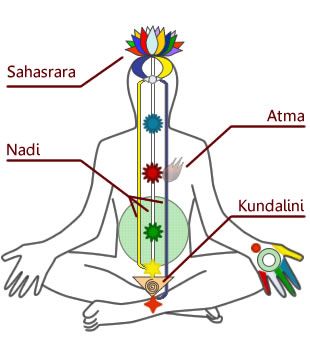 This link between the serpent, "awakening" and revealed knowledge is also present in Indian culture. It is no coincidence that Gnosticism has much in common with the basic conceptions of the Vedas of ancient India. The most obvious parallel lies in the name: the word "Veda" means "Knowledge", just like the word "gnosis". In the philosophy of Indian Yoga the coiled, sleeping serpent is the symbol of Kundalini: the dormant knowledge residing in the perineum, at the base of the spine. Through Yoga techniques it is awakened and rises up the spine, passing through the seven centres of power called chakras, to reach the crown of the head and pour out through the cranial suture (might the halo of Christian saints be considered a symbol of enlightenment?). The manifestation of the awakening of Kundalini is awareness and knowledge of past, present and future, an expansion of consciousness.
Our journey, which began in Abruzzo, has ended in India, showing once again the power of the symbol as the common thread of the aspirations towards the divine shared by peoples and religions. The symbol transcends the concepts of time and space to become universal knowledge. Revealed knowledge, perhaps?
Bibliography:
- Dizionario dei soggetti e dei simboli nell'arte (Dictionary of Subjects and Symbols in Art), James Hall, Longanesi
- Bominaco, Serafino Lo Iacono OSB., Bominaco 1995
- Treccani.it, Enciclopedia dell'Arte Medioevale
- La Triplice Via del Fuoco nel Mosaico di Otranto, Francesco Corona, Atanòr
- I Re Pellegrini (The Holy Kingdom), Adrian Gilbert, Corbaccio
- I Vangeli Gnostici (The Gnostic Gospels), Elaine Pagels, Oscar Mondadori
- Il Libro dei Morti degli Antichi Egiziani, G. Kolpaktchy - D. Piantadina, Atanòr
Originally published in Italian on the Montezaga blog (montezaga.wordpress.com) →