The Mandylion of Manoppello
PhotoThe Holy Face in the Sanctuary of Manoppello (photo by Ra Boe)In August 2009 we arrive at the Sanctuary of Manoppello. It is surrounded by the green woods of the Majella, which temper the great heat of the summer day. We are thrilled by the magnificent scenery that has accompanied us on the journey from the coast into the Abruzzo hinterland, always rich in breathtaking views, in light and colours that go straight to the heart, in land and cultivated fields whose produce we can already taste. Oil, vegetables, fruit, wheat... yes, wheat, because Manoppello takes its name from Roman times: it refers to a bunch of ears of wheat held in the hand.
The great valleys wind into the dark mountains in the distance, and you fall silent in admiration. Because the whole meaning of humankind and nature is there: the toil of work, and the search for the supernatural within us and in the architecture of the universe.
We have arrived and we are happy, because travelling through this countryside relaxes the mind and puts you in the right frame of mind to appreciate what you encounter along the way. Above all, always, in our wanderings around Abruzzo we have strongly felt the presence of a vital spiritus loci and the scent of the past that still intoxicates those who seek within themselves the vigorous roots of ancient cultures. And Manoppello does not disappoint.
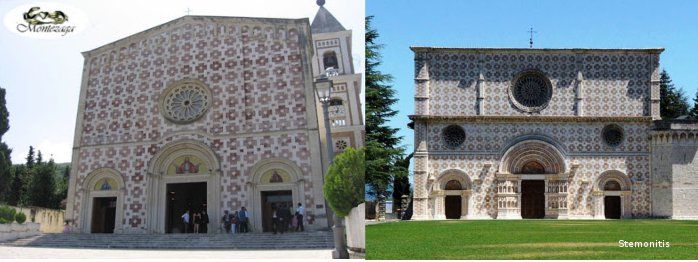
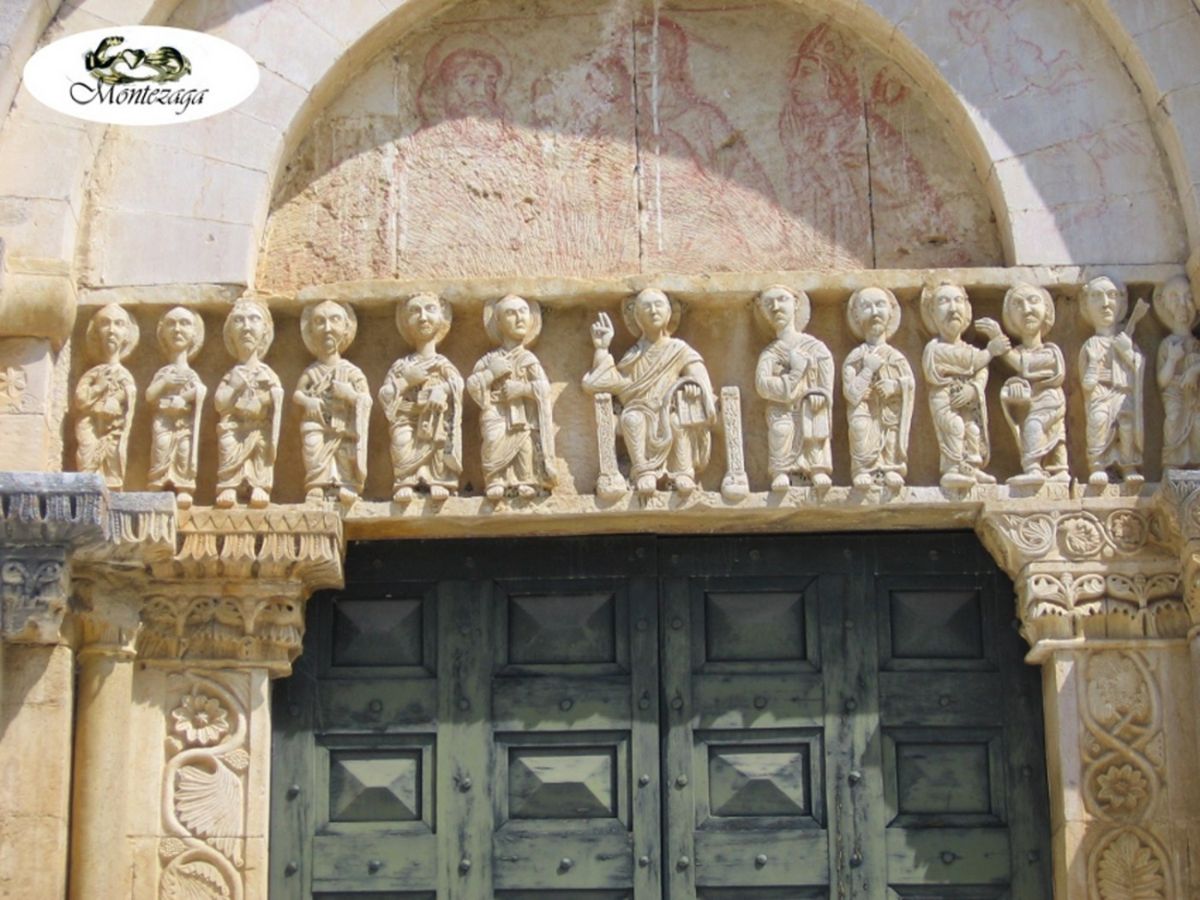
The Sanctuary of the Holy Face reminds us of something, but we are looking for the hidden signs, those that can be read on the capitals of ancient columns or beneath flaking frescoes that let older, more honest wall paintings show through, until "the strange", "the out of place" comes back before us in close-up, "full screen": it is as if the Basilica of Collemaggio had been transported here, in different forms but with all its charm as a rose-pink sugared-almond box... What gift do they conceal? And why?
Why are two buildings so far apart in time so similar in their façades decorated with alternating white and pink stones, like a light veil of lace? What are they covering so delicately?
Certainly the Sanctuary of Manoppello devoutly guards the Holy Face of Jesus, the cloth bearing the acheiropoieta (not made by human hands) imprint of Christ's face, while the Basilica of Collemaggio houses and venerates the remains of the "poor hermit" Pietro Angeleri, who in 1294 became Pope with the name Celestine V.
So is there perhaps a subtle thread that binds these two relics together and weaves through the façades of these two monuments? At this point we need to retrace medieval history in order to venture a few hypotheses.
In 302 BC, in Mesopotamia, in the region called Osroene, between the Anti-Taurus mountains and the river Balikh, a tributary of the Euphrates, the city of Edessa was founded by Seleucus, a general of Alexander the Great.
The Seleucid dynasty kept control of the city and of Osroene for about two centuries, until in 130 BC the Aryu dynasty seized the throne of Edessa. These kings, who handed down the name Abgar through the generations, managed to maintain their authority and power by exploiting their position as a buffer state between Parthia to the east and Roman Syria to the west.
After shifting political fortunes and bitter battles, in AD 212, under the son of Abgar VIII the Great, Edessa and its principality lost their independence, becoming first a Roman colony and then being annexed to the Roman Empire.
The last of the Abgars established Christianity as the state religion.
The Christian world of the first millennium knew Edessa above all for its possession of the miraculous image of Jesus: the Holy Mandylion.
According to legend, King Abgar V, afflicted by a serious illness and having heard of the healing power and the miracles Jesus was performing in Galilee, sent three of his court officials to Jerusalem with a letter inviting Jesus to come to Edessa, where he would be welcomed as the Redeemer, so that he might relieve him of his ills. The three met Jesus, and on that occasion Abgar's artist and secretary, Hannan, was able to portray the Master's face.
Be that as it may, Jesus declined the invitation, promising that once his divine mission was accomplished he would relieve Abgar of his sufferings, since he had believed in him without seeing him. In his letter of reply Jesus apparently says: "...those who see me will not believe in me, and those who do not see me will believe in me and live..."
According to the legend, after the death of Jesus the apostle Thomas sent Thaddeus, one of the seventy disciples, to the court of Edessa, where Abgar, struck by the transfiguration that miraculously appeared on Thaddeus's face, was immediately healed of his illness; having converted to Christianity, Edessa became the first Christian city.
This is where the portrait of Jesus painted by the court secretary Hannan comes in. Abgar held in great esteem the image of Jesus, whom he had never had the chance to meet but who had brought about his miraculous healing.
Other sources and traditions consider the Mandylion to be either the cloth Jesus used after being baptised by John in the Jordan, or the veil with which Saint Veronica wiped the blood from the Master's face during the Passion on the way to Calvary. The features of Christ were miraculously imprinted on the veil. The existence of Saint Veronica is not proven, and her name very probably derives from the Latin "vera icona", true image, as the depictions of Jesus were called in the Middle Ages: although they were copies, they were venerated because they were painted in his true likeness.
On the death of Abgar V in AD 50, pagan cults were restored in Edessa, but despite persecution the Christians hid the original Mandylion and the correspondence between Abgar and Jesus within the city walls.
In the 2nd century AD, under Abgar VIII the Great, Edessa became a Christian city once more, and a full three centuries later, under the Eastern Roman Empire, the true icon of the face of Jesus was rediscovered and took on the status of a most precious relic, drawing ever more pilgrims from all over the Christian world.
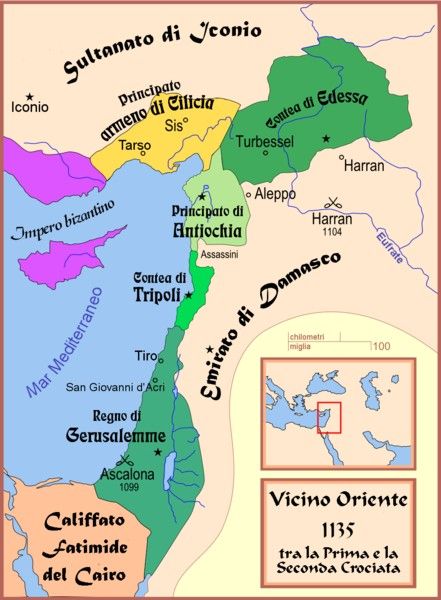
In AD 639 the Arabs conquered northern Mesopotamia and Edessa with its relic. In AD 943 Byzantium requested and obtained from the Arabs the return of the Holy Mandylion, which was triumphantly displayed in Constantinople in the Cathedral of Hagia Sophia and later kept in the Imperial Palace. Until the sack of Constantinople in 1204 the Mandylion was listed among the imperial treasures, but from then on all trace of the sacred Byzantine True Icon is lost.
In the Middle Ages all of Christendom venerated the now lost Holy Face as the real imprint of the face of Jesus before the crucifixion: the only object, hidden who knows where, soaked in the blood of Christ as well as depicting his true features.
Amid this religious fervour, "the Order of the Poor Knights of Christ", the Templars, also set out from France in search of the Mandylion.
By virtue of their rule, the Templars, as an independent order subject to no authority, political or ecclesiastical, except that of the Pope, enjoyed freedom of action. It is plausible that, suspecting that it was not the true Mandylion but a copy that had been handed over to Byzantium, and that the original was therefore still kept secretly in Edessa, they directed their search for the legendary relic towards that city. Was it found? Where was it taken: to be displayed once more as a banner of faith or, more likely, to be kept in a sacred and secret hiding place?
We know that there are at least three Mandylions in Italy, which arrived after passing through many hands. They are currently displayed in Genoa, in Rome and in Manoppello.
We can rule out the first two being Hannan's painting: the Genoa relic is probably a copy given in the 1400s to Doge Montaldo by the Byzantine emperor John V Palaiologos, and the Rome painting, now kept in the Vatican, is actually painted on a panel. But what about the Mandylion of Manoppello? The geographical location of this Abruzzo town in the province of Pescara is interesting in itself. It lies on the slopes of the Majella massif, and the site has been inhabited at least since Roman times: a patrician villa dating from around the 1st century BC, the subject of recent archaeological excavations, has been found near the town.
From Manoppello, climbing the Majella southwards, you reach Roccamorice, home to the ancient Celestinian hermitage of Santo Spirito.
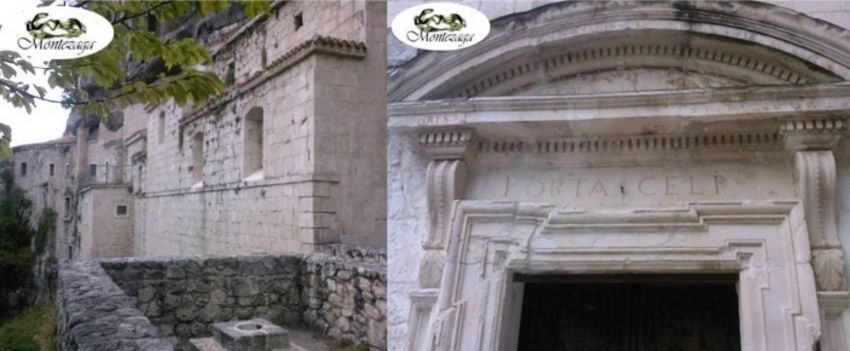
In Abruzzo, in the Early Middle Ages, between Monte Morrone and the Majella massif, the eremitic life was born and spread. The limestone rocks carved out by numerous watercourses offered monks, who sought contact with the divine through solitary meditation and a return to the poverty of early Christianity, caves and shelters that over time were adapted with small chapels and dormitories. Petrarch himself called these mountains "domus Christi".
In 1246 the hermitage of Santo Spirito housed Pietro da Morrone, who in 1294 would become Pope with the name Celestine V.
The figure of this hermit is decidedly unusual, both for his story as it has come down to us, which raises questions in any case, and for what his actions reveal without fully disclosing. His very birth (1209-1215?) and his surname (Angelerio-Angeleri?) are still debated today. He was probably born in the Apennine districts between Abruzzo and Molise.
As a young man he joined the Benedictine community of Benevento, but his strong longing for contemplation and asceticism led him to the Abruzzo peaks, where he lived in complete isolation in the caves near Monte Porrara and Monte Morrone. His name and reputation nonetheless spread among ordinary people, the clergy and the nobility.
Men eager to share his religious experience joined him, founding the "Congregation of the Penitent Brothers of the Holy Spirit", later called the Celestines.
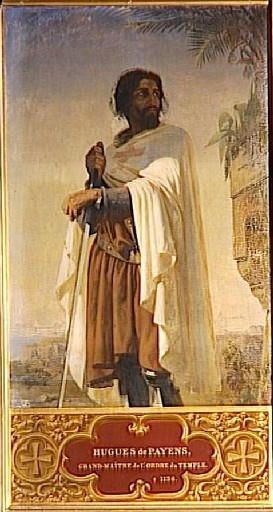
History does not record Pietro's first encounters with the Templar Order, but in 1274, during his journey on foot to Lyon, where at the Second Council of Lyon Pope Gregory X intended to dissolve several monastic orders including the Celestines, he was hosted for two months in a Templar house. This "naive hermit" succeeded in having the status of his monastic order preserved. Did the Templars intercede? What kind of relationship developed between Pietro and the Templars during his stay in France? Let us remember that the origins of the Order of the Temple are well documented. It was first formed by a group of nine knights from the French region of Champagne, led by Hugues de Payens.
Considering his subsequent actions, we suppose that Pietro brought back from France something particularly precious, which the Templar Order perhaps felt was in danger of being seized. That same year, on his return from France, Pietro decided to build, near L'Aquila on the Colledemajo hill, what in 1288 would be consecrated as the Abbey of Santa Maria di Collemaggio.
From his position as a "humble hermit", Pietro managed to complete this work, whose forms contain many elements of Templar symbolism, not least the striking two-colour dualism of the façade. The link between the Order of the Temple and the "cathedral builders", who created architectural masterpieces culminating in the Gothic style, is well known.
What did Pietro house in Collemaggio?
Meanwhile, in 1285, he acquired the Monastery of San Pietro di Vallebona, on the top of the hill above the present Sanctuary of the Holy Face, giving the Celestinian monastery of Sant'Antonio at Campo di Giove in exchange. It is said, however, that the Mandylion was already known in this area before the present Sanctuary was built in the early 1600s.
Today the Sanctuary of the Holy Face belongs to the order of Capuchin friars.
In the Middle Ages the Capuchins, seeking to observe the original Franciscan rule, found in Abruzzo the ideal place to carry out their mission of poverty, so much so that they were nicknamed the "Poor Hermits of Celestine" because of the protection Pietro da Morrone granted them as soon as he became Pope.
In 1294 Pietro, in his hermitage, was asked by the King of Naples, Charles of Anjou, to urge the cardinals gathered in conclave to elect a new Pope, since the papal throne was vacant while the cardinals were divided by political conflicts. Pietro agreed, and his letter to the conclave, warning of grave consequences for the Church, was followed by the cardinals' decision to choose him as the new pontiff: the "poor hermit" known in all the royal courts of Europe for his great morality and piety. In his hermitage the friar at first refused the office but later submitted in obedience, and on 29 August 1294 he was crowned Pope, not in Rome but in the Basilica of Collemaggio that he had built. He arrived there riding a donkey led by the bridle by Charles of Anjou, King of Naples, and by his son Charles Martel, King of Hungary.
During Celestine V's time as a hermit and his subsequent accession to the papal throne, the Orsini family ruled Manoppello, until around the 1400s, when it passed to the Colonna. Since it was thanks to the support of the Orsini family, already linked to the Anjou and the Del Balzo, that Pietro da Morrone was elected Pope, we may suppose that this powerful house's control of the Manoppello area made it safe enough to guard something supremely dear to Pietro, perhaps entrusted to him by the Knights Templar.
Beyond the historical events concerning the internal struggles between temporal power and the power of the Roman Catholic Church, we wanted to highlight the common thread linking the Templars, the monastic orders and Saint Pietro da Morrone, leading to the precious Byzantine relic: the Mandylion. We may suppose that at his meeting with the Templars in Lyon, Pietro was entrusted with the ancient veil, which was first kept in the Basilica of Collemaggio and later, for safety, taken to San Pietro in Vallebona and handed over to the "Poor Hermits of Celestine" under the protection of the Orsini family. Let us remember that over his lifetime Pietro da Morrone founded and restored hermitages and monasteries, including San Liberatore a Majella, San Bartolomeo at Roccamorice, Santo Spirito del Morrone, Santa Maria d'Arabona at Manoppello and San Tommaso at Caramanico.
We do not know whether the relic currently displayed in the Basilica of the Holy Face is the original Mandylion or rather a copy of the one Pietro presumably brought from Lyon. Nor do we know whether the imprint on the byssus cloth is the image of Christ worshipped as the Son of God by the Catholic Church, or of Adam Kadmon, the perfect spiritual man, the model of reference for Gnosticism. One thing seems clear to us: the importance of this figure for both creeds.
We also wonder why Celestine abandoned the papal throne after only 107 days, fleeing and seeking refuge overseas in Greece aboard a ship provided by the Templar Order, which was wrecked in a storm. Historical sources report that, on the orders of Cardinal Benedetto Caetani, newly elected as his successor with the name Boniface VIII, Celestine V was captured and imprisoned in the fortress of Fumone, Caetani's own property, where he died on 19 May 1296 in unclear circumstances. There is no doubt that Celestine V's brief pontificate called into question the Roman see as the centre of Christendom, and that the election of Boniface VIII restored the old political and religious balance. This is the context for the later events involving the Templar Order, its destruction in 1314 and the so-called "Avignon captivity" in 1309 under the French Pope Clement V. Boniface VIII's hopes of keeping Rome as the seat of the papacy were short-lived, and new scenarios soon opened up...
Bibliography:
-
L'Altro Impero Cristiano, Eduardo R. Callaey, Tropea
- Il Medioevo, ed. Umberto Eco, EncycloMedia
- I Re Pellegrini (The Holy Kingdom), Adrian G. Gilbert, Corbaccio
- Grandi Itinerari Automobilistici nel Paesaggio Italiano, T.C.I.
- Il Libro che la tua chiesa non ti farebbe mai leggere (The Book Your Church Doesn't Want You to Read), Tim C. Leedom - Maria Murdy, Newton Compton Editore
Copyright © 2012 Montezaga. All rights reserved.
Some images in this article are hosted on external sites and open in a new tab.
🇮🇹 Leggi questo articolo in italiano →Originally published in Italian on the Montezaga blog (montezaga.wordpress.com) →